
A Smarter Way to Run a Small Property Management Company: 6 Tools to Explore
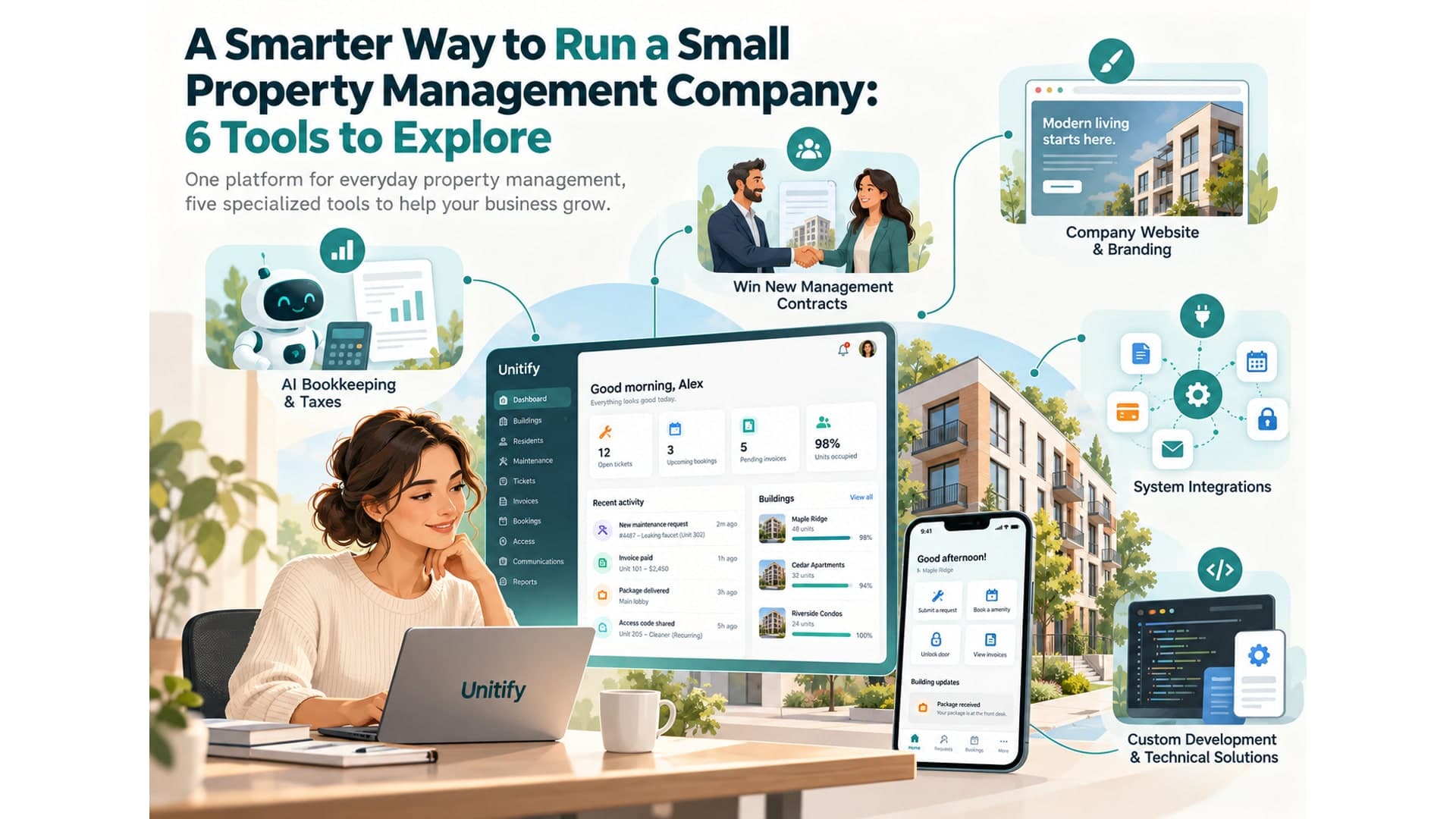
Six specialized tools to help your business grow.
Running a small property management company means handling the responsibilities of a much larger organization with a smaller team. Residents need answers, maintenance requests need attention, bills must be delivered, contractors need coordination, and new buildings need to be brought into the portfolio.
The right technology can make this manageable without hiring a separate employee for every task.
Unitify brings residential building operations together in one platform, from resident communication and maintenance to billing, payments and shared amenities. Five complementary tools help with tasks outside daily property management: Jupid for US business bookkeeping and taxes, Invental Partners for lead generation, Feely Studio for website design, Albato for external integrations and Devstark for custom software development.
The idea is simple: keep building operations in one place and add specialized services only where they bring value.
Key takeaways
- Unitify provides one workspace for resident communication, maintenance, billing, payments, building access and shared amenities.
- Small property management teams can coordinate multiple buildings without maintaining separate systems for every operational task.
- Jupid helps eligible US business owners and LLCs manage bookkeeping, expenses and taxes.
- Invental Partners and Feely Studio help management companies attract potential clients and present their services professionally.
- Albato and Devstark can support additional integration and development requirements when existing platform capabilities are not sufficient.
Which tools does a small property management company actually need?
- Building and resident management: Unitify — Resident app, maintenance, billing, payments, building access and amenities
- Business bookkeeping and taxes: Jupid — AI expense categorization, tax deductions and tax preparation
- Finding new management contracts: Invental Partners — B2B lead generation, prospect research and outbound campaigns
- Company website and branding: Feely Studio — Website design, development and visual identity
- External application integrations: Albato — Connecting supported applications and automating workflows
- Custom software development: Devstark — Custom software and specialized technical solutions
These tools serve different purposes. Unitify provides the operational foundation for managing residential buildings. The other five address specific business needs.
1. Unitify: One platform for everyday property management
Unitify is an all-in-one platform for managing residential buildings, condominiums and homeowners associations.
In a small management company, one person may be responsible for communicating with residents, coordinating repairs, monitoring invoices and preparing reports. When these tasks are spread across spreadsheets, messaging apps and separate databases, even routine work becomes unnecessarily complicated.
Unitify connects these processes in one operational environment. The platform includes a resident app, a management dashboard and a dedicated application for maintenance teams.
How can a small team manage resident requests and maintenance?
Residents submit requests through the Unitify app or supported communication channels. Each request becomes a ticket that can be classified, assigned and tracked.
Managers see outstanding issues in one dashboard, while technicians receive tasks through their own application. Equipment records and maintenance history help teams understand recurring problems and plan further work.
Unitify's AI tools assist with request classification, prioritization and routine communication, reducing the amount of manual work involved in processing incoming requests.
For a small team managing several buildings, this means fewer messages to forward, fewer spreadsheets to maintain and a clearer picture of what needs attention.
Can billing and payments work in the same system?
Unitify's billing tools help management companies calculate charges, generate invoices and deliver them to residents.
Residents can view their bills in the app and make payments where supported payment integrations are available. Management teams can track billing information alongside other building operations.
This keeps financial interactions with residents connected to the building's operational records.
What else can residents do in one app?
The Unitify resident app provides access to everyday building services, including:
- Building announcements and notifications
- Maintenance requests and status updates
- Bills, payments and meter readings
- Guest and vehicle passes
- Shared-space reservations
- Resident voting and surveys
- Supported intercom and access-control systems
A resident can report a problem, book a shared facility or receive an important announcement without switching between different applications.
Management teams can configure services according to each building's needs.
Can Unitify connect with existing systems?
Yes. Unitify provides an Open API and supports integrations with external business software, payment providers and building equipment.
Depending on the project, a management company may need to connect an existing ERP or accounting system, an access-control solution, smart meters or another specialized application.
Unitify supports integrations through available interfaces, while specific connections depend on technical compatibility and implementation requirements. Accounting information can also be exchanged through supported file formats.
The goal is to maintain one central operational workspace while allowing the company to retain specialized external systems where necessary.
Best for: Small and growing companies managing residential buildings, condos and HOAs that want to centralize operations and reduce administrative work.
What to consider: Available payment methods and building equipment integrations depend on the local market and technical configuration.
Pricing: Unitify offers a free plan and paid plans based on the number of apartments. See current pricing.
2. Jupid: AI bookkeeping and taxes for the management business
Jupid handles a different part of running a property management company: the finances and taxes of the business itself.
A company managing residential buildings also has its own expenses, including software subscriptions, office equipment, marketing, professional services and contractor payments.
Jupid is an AI-powered accounting platform designed for US freelancers, independent business owners and LLCs.
It connects to bank accounts, automatically categorizes transactions, identifies potential tax deductions and prepares financial reports. Its features include quarterly tax estimates, Schedule C preparation for eligible taxpayers, federal and state tax filing services and CPA review.
Business owners can also interact with Jupid through WhatsApp and iMessage.
For example, an independent property manager running an LLC could use Unitify to manage buildings and resident services while relying on Jupid to organize the company's own expenses and prepare tax information.
Best for: US independent property managers, sole proprietors and LLC owners looking to automate business bookkeeping and tax preparation.
What to consider: Jupid is not a replacement for specialized HOA accounting, client trust accounting or property-level billing. Schedule C does not apply to every LLC tax classification.
Pricing: Jupid Solo costs $50 per month or $390 annually. The Team plan costs $200 monthly or $1,560 annually. See Jupid pricing.
3. Invental Partners: Finding new buildings to manage
Winning new property management contracts requires a different set of skills from operating existing buildings.
A company may provide excellent maintenance and resident services but still struggle to reach developers, property owners or HOA boards looking for a new management provider.
Invental Partners specializes in B2B lead generation, prospect research and outbound campaigns.
Its services include identifying potential clients, researching decision-makers, building targeted contact lists and conducting personalized outreach through email and LinkedIn.
For a property management company, a potential application would be developing a campaign aimed at residential developers, property owners or organizations considering a change of management provider.
Invental Partners is a general B2B outreach specialist rather than a dedicated property management lead generation platform. Campaigns therefore need to be adapted to the company's market and target audience.
Unitify can support the next stage of the sales process by giving the management company a clear digital operating model to demonstrate to prospective clients.
Instead of describing how maintenance requests or resident communication will work, the company can show the platform it intends to use.
Best for: Property management businesses looking to expand their portfolio and develop systematic B2B outreach.
4. Feely Studio: A professional website and digital presence
A property management company's website is often the first place a potential client encounters the business.
Developers, property owners and HOA boards want to understand the company's experience, services and approach before arranging a meeting.
Feely Studio provides brand identity, website design and development services, including projects built with Framer and Webflow.
A management company could work with a studio to create a website that explains its services, presents completed projects, introduces its team and makes it easy for potential clients to get in touch.
A public corporate website serves a different purpose from a property management platform.
The website helps the company attract clients and communicate its value. Unitify supports the daily operation of the buildings once they are under management.
These are complementary functions, and the same information does not need to be maintained in multiple operational databases.
Best for: Management companies establishing their market presence, updating an outdated website or preparing to approach larger clients.
5. Albato: Connecting additional business applications
Keeping building operations in one platform does not mean a company must abandon every system it already uses.
An established property management business may have external applications for sales, accounting, marketing or other specialized processes.
Albato is an integration and automation platform that connects supported cloud applications through prebuilt connectors and configurable workflows. It also offers API-based integration capabilities.
For example, a management company might want information from a website inquiry form to reach an external sales CRM automatically, or certain business events to trigger notifications in another application.
Unitify already provides an Open API and supports integration projects. Albato may be considered when additional external application workflows are needed.
The feasibility of a specific connection depends on the APIs and operations supported by each system. A ready-made native integration between Albato and Unitify should not be assumed.
Before adding another automation tool, a company should check whether the required process can already be handled inside Unitify.
Best for: Businesses that use external cloud applications and need additional automation between supported systems.
6. Devstark: Custom software for specialized requirements
Most everyday property management tasks should not require custom software development.
However, some companies manage buildings with unusual technical infrastructure, legacy systems or specialized business requirements.
Devstark develops custom software and AI-based business solutions.
A development partner may be useful when a property management company needs a specialized interface, a connection to proprietary software or functionality that cannot be implemented through standard configuration.
For example, a residential developer might already operate a proprietary ERP system and need a technical solution for exchanging selected information with its property management platform.
Unitify's API and integration capabilities provide a starting point for assessing such requirements. A development partner can evaluate whether additional software is necessary and how a connection could be implemented.
The objective is not to create another property management platform from scratch. It is to address exceptional technical requirements while keeping core building operations centralized.
Best for: Management companies and developers with specialized IT requirements that cannot be met through existing software configuration.
How can a small property management company run several buildings with fewer tools?
Consider a company managing five residential buildings with a small office team and several maintenance contractors.
Throughout the day, residents report problems, receive invoices, submit meter readings, request guest access and book shared facilities. Technicians complete repairs, while managers monitor outstanding work and prepare reports.
Without a centralized system, these activities may involve separate spreadsheets, messaging applications, billing software and paper records.
With Unitify, the building-related workflows can operate within one platform. Residents interact through their app, technicians receive assignments, and managers monitor operations from a central dashboard.
The management company's other business activities can remain separate.
Jupid can help the owner organize business bookkeeping and eligible US tax filings. Invental Partners can support the search for new clients, while Feely Studio can help present the company's services online.
If an external system needs to exchange information with the operational platform, Unitify's integration capabilities can be evaluated. Additional tools or custom development can be considered when necessary.
This creates three clear areas of responsibility:
- Running buildings: Unitify manages everyday residential operations, residents, maintenance, billing and services.
- Running and growing the business: Specialized providers support accounting, marketing and business development.
- Connecting existing systems: Supported integrations and custom development handle requirements outside the core platform.
The result is a simpler software environment with clear responsibilities and less duplication.
One platform for buildings, specialized tools for business growth
Small property management companies need many of the same capabilities as larger organizations. They do not necessarily need the same number of employees, departments or software systems.
The most practical approach is to keep everyday building operations together and use complementary services for tasks that genuinely require different expertise.
Unitify connects residents, managers, technicians, building services and infrastructure in one platform. Specialized tools can support accounting, client acquisition, marketing and exceptional technical requirements.
Keep building operations in one place. Connect external systems when needed. Spend less time managing software and more time managing properties.
Frequently asked questions
What software does a small property management company need?
A small company managing residential buildings typically needs software for resident communication, maintenance, billing, payment tracking and operational reporting. Unitify combines these functions in one platform. Additional tools may be useful for the company's own accounting, marketing and business development.
What is the best all-in-one software for a small HOA management company?
An HOA management company should prioritize a system that keeps resident information, maintenance, billing and building records together. Unitify provides these functions along with resident voting, shared-space booking and supported building access integrations.
Can Unitify replace separate maintenance, booking and resident communication apps?
Yes, for the workflows supported by its modules. Unitify includes maintenance request management, resident communication and booking functionality within one platform. Residents access services through one app, while managers and technicians work in connected operational interfaces.
Does Unitify integrate with accounting and ERP systems?
Unitify provides an Open API and supports integration projects involving external business systems. Accounting information can also be exchanged through supported file formats. Specific integration capabilities depend on the external system, available interfaces and implementation requirements.
Does a small property management company need separate accounting software?
Building billing and company bookkeeping are different tasks. Unitify handles building-related charges, invoices and payment workflows. A specialized tool such as Jupid can help eligible US business owners manage their own company's expenses and taxes.
How can a small property management company grow without increasing administrative staff at the same rate?
Centralizing recurring work can reduce the time spent coordinating requests, communicating with residents, monitoring payments and preparing operational information. A management platform such as Unitify supports these processes, while specialized business development services can help companies reach new clients.