
Contractor marketplace: tasks out, work done, paid through local partners
Several countries now give individuals who take on small jobs a simple special tax status, and some say why in the statute itself: Brazil’s calls its regime a public policy for formalising small businesses, and Colombia’s says its regime exists to promote formality. For building maintenance, that opens a documented alternative to paying odd jobs in cash.
Unitify’s contractor marketplace lets a management company mark a maintenance ticket available to outside performers — registered firms, individual entrepreneurs, and self-employed individuals where local law allows it — approved by Unitify, and pay per accepted task instead of cash in an envelope. Payouts and the tax paperwork run through a local partner in each country where the pilot is open; Unitify is not the payment operator.
What it does
Handle a spike without hiring
Publish more tasks when work spikes — after a storm or a building-wide renovation, publish extra cleaning tasks and close them the same day — instead of carrying idle capacity the rest of the year.
Pay per accepted task
Each payout is tied to an accepted, closed ticket, with its photo trail in the record — so what you pay for is exactly what got done.
See requests & techniciansCashless, documented payouts
Payouts run through a local partner where one is in place, instead of cash in an envelope, so every payment leaves a record the company can point to.
Residents can be performers too
Where local law allows it, a resident of the building can take on a task the same way an outside contractor would. Decide in advance how you handle work by residents and board members.
The work history stays with the company
Every closed task stays attached to the building’s own equipment and maintenance record — not locked in a departing contractor’s own paperwork.
See equipment & maintenance history
How it works
Mark the ticket available to contractors
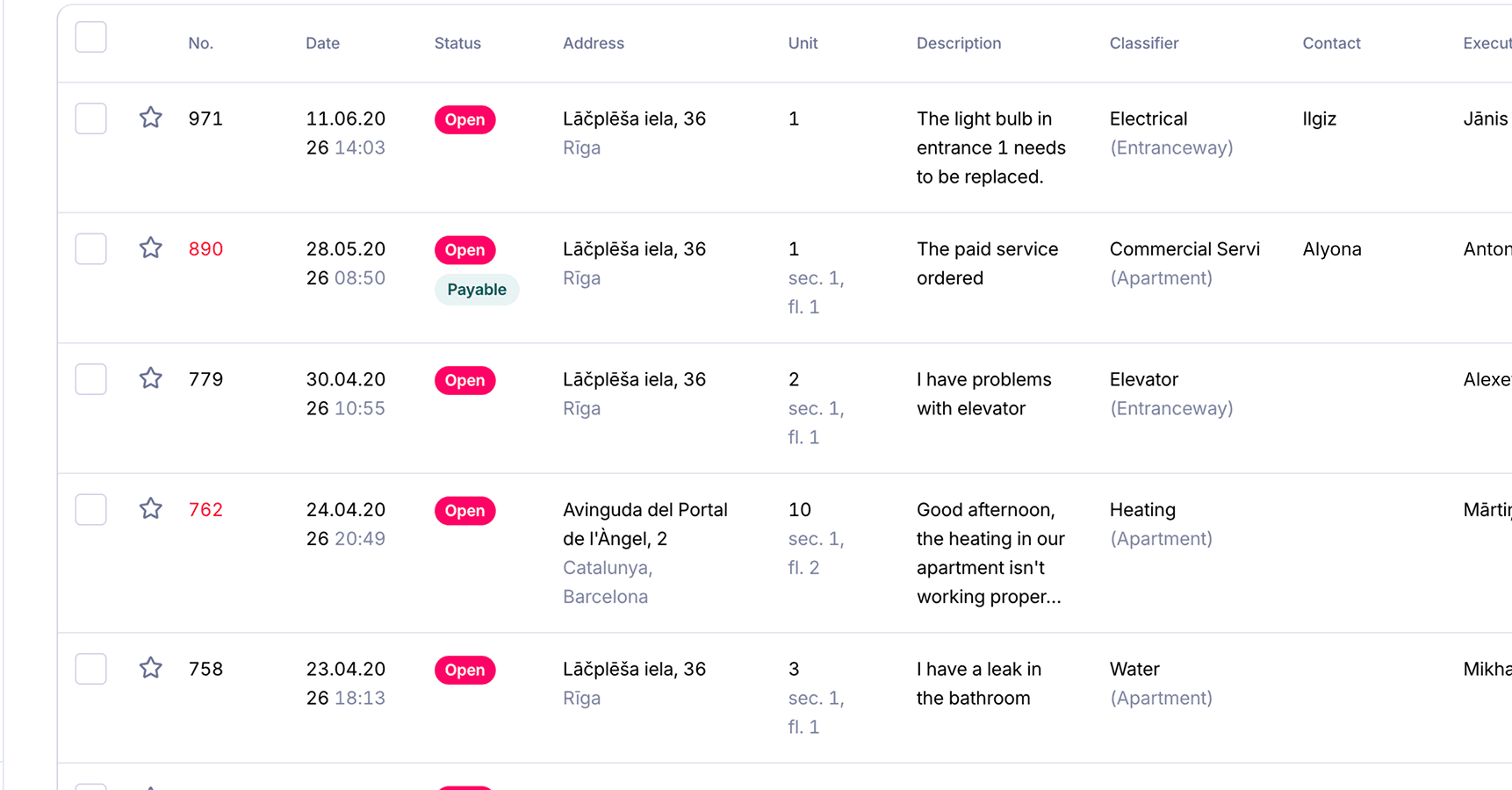
On a maintenance ticket’s classifier, the management company ticks Available to contractors — the same ticket the technician app already tracks.
An approved performer picks it up
The task appears to performers approved by Unitify in the Marketplace tab of the technician app, alongside Today, Mine and All.
The task closes, the payout goes through a local partner
The performer completes and closes the task with its photo trail. Payout and tax paperwork are handled by a local partner in countries where one is in place.
Pilot: marking tickets and the Marketplace tab work today; payouts open country by country as local partners are signed. Ask us about your country.
What it does not do
- This is a pilot: payouts open in a country only once we have verified its regime and lined up a local partner.
- Payouts run only where a local partner is in place; without one, the marketplace is not open in that country yet.
- Where the performer is self-employed, the trades on offer are limited to what that country’s regime actually permits.
Independent does not mean informal.
In every country where this feature is available, a contract with an independent performer can be re-characterised as an employment contract — by a court, and in some countries by a labour inspector, and in one country automatically, by operation of law, from the day the contract was signed.
What drives that outcome is not the wording of the contract. It is the shape of the working relationship: whether the person performs a defined job function rather than a result; whether they are subject to your schedule, your rota or your internal rules; whether they work for you and essentially no one else; and whether the arrangement is continuous rather than task by task.
A dispatching system makes those questions sharper, not softer, because it creates a record of exactly how each task was assigned and controlled.
Unitify provides the routing and the record. Unitify does not decide anyone’s employment status and does not advise on it. Before you move existing work onto the marketplace — and in particular before you move any person who is or was on your payroll — take local legal advice. In several of the countries listed here, the permitted activities, the customer you are allowed to work for, and the documents your accountant needs are all set by statute and differ from one country to the next.
Where individuals under a special tax or self-employment regime could take part
In these countries we have verified a legal route for individuals doing this kind of work, and each comes with its own constraint. The route opens in a country only once a local partner is in place to handle payouts and the tax paperwork.
Argentina
In Argentina, a Monotributista pays fixed monthly amounts that replace income tax and VAT and cover pension and health contributions, and must invoice every sale; since March 2026 the Labour Contract Law no longer presumes employment where a works or trade contract is invoiced or paid through the banking system. On the marketplace, performers must be registered Monotributistas; the company pays against their invoice, and payouts run through a local partner once one is in place.
Ley 24.977, Anexo (Monotributo); Ley de Contrato de Trabajo, art. 23, infoleg.gob.ar ↗Colombia
Colombia’s Régimen Simple de Tributación was created, in the words of the statute, to reduce formal burdens and promote formality; electricians and masons are expressly within it, and a company paying a SIMPLE taxpayer does not withhold income tax but receives an electronic invoice. On the marketplace, performers must be registered in the SIMPLE regime; the company pays against a factura electrónica, and payouts run through a local partner once one is in place.
Estatuto Tributario, Régimen Simple (SIMPLE), arts. 903–916, secretariasenado.gov.co ↗Georgia
Georgian micro-business status gives 0% income tax up to GEL 30,000 a year, and an owner may do common-property work themselves against a reduction in their own contribution. Where a company pays a micro-business individual, the cost is deductible only if the prescribed document, stating the performer’s status and certificate number, is issued at the time of supply; payouts run through a local partner where one is in place.
Tax Code of Georgia, arts. 83–98²; Law on Homeowners’ Associations, art. 22(8) ↗Kazakhstan
Kazakhstan’s 2026 Tax Code created a special tax regime for the self-employed: 0% income tax and 4% in social payments, for individuals earning up to 300 MRP a month, in the activities listed by the Government. Where the work runs through an internet platform, Kazakh law makes the platform operator the tax agent for the performer’s income tax and social payments, and lets the performer authorise the platform’s app to issue the statutory receipt. In the pilot, that role (the payout, the withholding and the receipt) sits with a local partner, not with Unitify, and Kazakhstan opens only once that partner is in place. On the marketplace, only the activities in Government Resolution No. 994 are open to self-employed performers: general cleaning of residential buildings, plastering, carpentry, floor and wall finishing, painting and glazing. Plumbing, electrical work, landscaping and snow clearance are not.
Tax Code of Kazakhstan, Ch. 77; Government Resolution No. 994 ↗Kyrgyzstan
A Kyrgyz performer works under an electronic patent bought in advance for one activity in one district, plus a separate monthly social-insurance contribution. The patent for construction and repair work expressly excludes work for organisations and individual entrepreneurs, so a management company cannot buy these trades from a patent holder.
Tax Code of the Kyrgyz Republic, Ch. 56 (patent), cbd.minjust.gov.kg ↗Spain
In Spain, a self-employed tradesperson on the objective-assessment method has 1% of each payment withheld by the business client; plumbing, electrical installation, masonry, carpentry, painting and plastering are named in the regulation. On the marketplace, performers must be registered autónomos, and any withholding (1% for tradespeople on the objective-assessment method) is the client’s to apply; payouts run through a local partner once one is in place.
Reglamento del IRPF (RD 439/2007), art. 95, boe.es ↗Uzbekistan
An Uzbek self-employed person registers by notification in the tax authority’s app and receives a QR code; turnover tax is 1% up to 1 billion soums and social tax is voluntary. Two limits shape its use: a self-employed person may not have an employer at all, and the permitted-activity list describes cleaning, minor plumbing and in-flat electrical work as services for natural persons. Whether a management company may buy these services from a self-employed person is not settled, so the pilot does not offer that route in Uzbekistan.
Law on Employment, arts. 35–37; Tax Code, lex.uz ↗We are verifying more countries’ regimes. Registered contractors (firms and individual entrepreneurs) can take tasks in every country where the marketplace is open, except that in Germany, Mexico and the United States only firms can (see below).
In Germany, Mexico and the United States the marketplace is open to contractor firms only, not to individuals working on their own. German law treats work done on instructions and integrated into the client’s organisation as employment for social-security purposes (§ 7(1) SGB IV). Mexico’s Federal Labour Law defines paid in-person work that a person or company manages for third parties through a digital platform, using it to direct and supervise the worker, as a subordinated employment relationship for any month in which the worker earns at least one Mexico City monthly minimum wage (arts. 291-A–291-C). In Mexico, contracting firms is itself subject to the Federal Labour Law’s subcontracting rules (arts. 12–15); take local legal advice first. US tests turn on the right to control the work, and in several states on whether it falls within the hiring company’s usual course of business.
Frequently asked questions
Who can join the marketplace as a performer?
Registered firms everywhere the marketplace is open, individual entrepreneurs except in Germany, Mexico and the United States, and self-employed individuals only where local law provides for it. Approval is admission to the marketplace; it is not a check of anyone’s tax or employment status.
Who pays, and how?
Payouts and the tax paperwork run through a local partner in each country where the pilot is open; Unitify is not the payment operator.
Is this legal in our country?
An independent contract can be re-characterised as an employment contract, and the rules differ by country — this page explains the risk in full before you turn this on. Take local legal advice before moving any existing work — especially work done by someone who is or was on your payroll — onto the marketplace.
Can residents of the building take tasks?
Where local law allows it, yes. Decide in advance how you handle work by residents and board members before you turn the pilot on.
Which countries are open in the pilot?
None yet for payouts. We have verified a legal route for individuals in Argentina, Colombia, Georgia, Kazakhstan, Kyrgyzstan, Spain and Uzbekistan, each with its own constraints. A country opens once a local partner is in place. Ask us where your country stands.
Related reading
- Beyond Maintenance: How Additional Services Boost Engagement
- Better Planning, Better Maintenance
- AI for Chief Engineers — and Why Digital Building Compliance Is Becoming Mandatory