
Managing Finances Across Multiple HOAs: From Resident Billing to Group Reporting
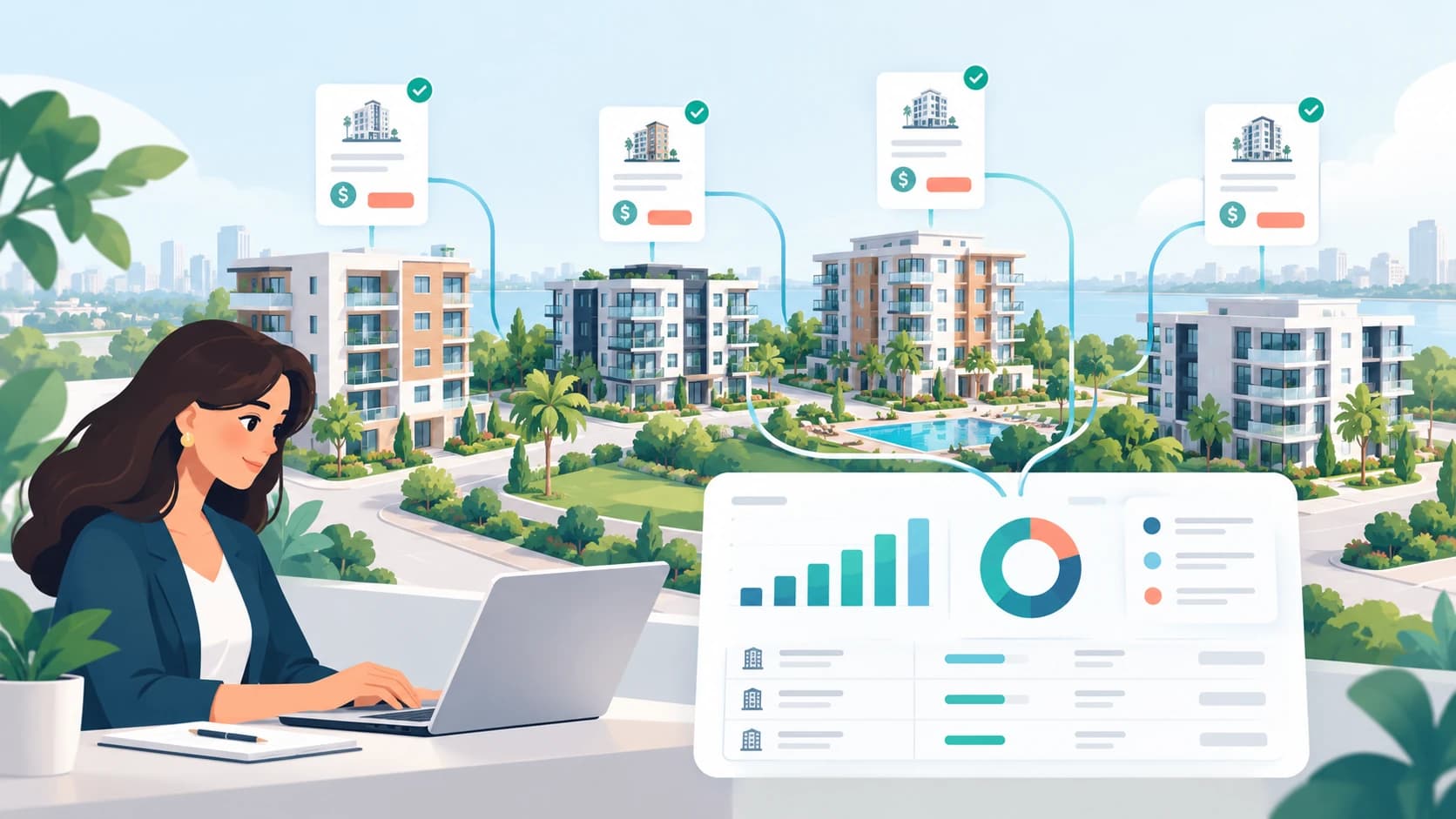
How property management companies can organize building-level charges, accounting and financial reporting across a growing portfolio.
Managing the finances of one residential building is already a complex task. Managing several HOAs, condominium associations or residential developments introduces different billing rules, payment schedules, bank accounts and reporting requirements.
The challenge is keeping each property's finances clear while giving the management company an accurate picture of the entire portfolio.
Two tools address different parts of this process. Unitify Easybilly automates building-level charges, invoices and resident payments. Helmstead brings financial information from multiple entities, currencies and accounting systems into a shared environment for review, reporting and planning.
They serve different purposes. Neither should be assumed to replace the formal accounting and financial controls required for individual associations.
Key takeaways
- Each HOA or residential building may have different rules for calculating and collecting charges.
- Unitify Easybilly generates invoices based on each building's rules and makes them available through the resident app.
- Property management companies need to distinguish building-level billing from formal accounting and company-wide financial reporting.
- Helmstead helps finance teams work with financial information across multiple entities and existing accounting systems.
- Neither product requires a management company to abandon all its existing financial software.
- Data exchange, account separation and financial review procedures should be defined before introducing additional automation.
What software does a property management company with multiple HOAs need?
- Monthly resident charges: Main requirement: Calculate fees according to each building's rules; Solution: Unitify Easybilly
- Resident invoices and payments: Main requirement: Deliver invoices and provide supported payment options; Solution: Unitify
- Building financial operations: Main requirement: Track charges, payments and opening balances; Solution: Unitify
- Formal accounting: Main requirement: Maintain accounting records and required financial statements; Solution: Existing accounting software
- Financial reporting across entities: Main requirement: Review information from multiple companies and systems; Solution: Helmstead
- Financial planning: Main requirement: Compare scenarios and assess future financial outcomes; Solution: Helmstead
These functions may be connected through suitable data exchange processes, but they are not interchangeable.
1. Why do finances become complicated when managing several HOAs?
Consider a property management company responsible for eight residential buildings.
Some buildings charge maintenance fees per square meter. Others use a fixed monthly amount per apartment. Certain buildings charge separately for parking, shared facilities or additional services.
Each association may also have its own budget, bank account and reporting obligations.
The management company has to calculate charges accurately, send invoices, monitor payments and answer residents' questions.
At the same time, its finance team may need to prepare financial information for the management company's leadership and for individual associations.
Three different financial responsibilities
Building billing. Calculating charges for individual apartments and distributing invoices to residents.
Association accounting. Maintaining the legally required records and reports for each HOA or condominium association.
Management company reporting. Understanding the financial performance, expenses and cash requirements of the company operating the portfolio.
These responsibilities may involve some of the same information, but they should not be combined into one undifferentiated set of accounts.
In particular, funds belonging to HOAs or property owners may need to remain legally and operationally separate from the management company's own finances.
2. Unitify Easybilly: Billing rules for every building in one platform
Unitify Easybilly is a billing module for property management companies, HOAs and developer-owned management organizations.
It automates recurring charges, generates invoices and makes them available to residents through the Unitify app.
For a company managing several buildings, the main advantage is being able to configure different billing rules without maintaining a separate spreadsheet-based process for every property.
For a closer look at how the billing process works, read Property Billing Without Spreadsheet Chaos. The article explains how management companies can import existing balances, configure building-specific charges and generate monthly invoices without rebuilding spreadsheets every month.
How are building charges calculated?
Easybilly supports several methods:
- Per square meter
- Per apartment
- Per resident
- A fixed amount
Each building retains its own billing configuration.
For example, one building might charge a monthly maintenance fee based on apartment area, while another uses a fixed fee per unit.
Both can be managed within the same Unitify environment, with the appropriate rules applied to each building.
How can a management company migrate existing records?
Easybilly supports importing apartment information, owners and opening balances from Excel or an existing system.
This reduces the amount of manual re-entry required when moving away from spreadsheet-based billing.
The management team can then configure the billing rules and prepare recurring invoices.
How do residents receive and pay invoices?
Invoices are delivered through the resident app, where occupants can review their charges.
Residents can also receive PDF invoices with QR codes.
Where supported payment integrations are available, payments can be made directly through the app.
The available payment providers depend on the market. Unitify's published integrations currently cover several countries, including Georgia, Kazakhstan, Uzbekistan, Armenia and Azerbaijan.
Payment processing should therefore be verified for the location of each property.
What makes this useful for multiple buildings?
A manager can work with the billing records of several properties without maintaining separate manual workflows for every building.
Residents can view their own charges, while management teams have access to the corresponding billing information.
Unitify also connects billing with other daily operations, including resident requests, building communication and maintenance.
This is particularly useful for smaller management companies where the same employees handle several administrative responsibilities.
Does Easybilly replace accounting software?
No.
Easybilly calculates charges, generates invoices and tracks billing-related information. It is not a replacement for a formal accounting ledger.
Accounting information can be exported through Excel or exchanged using supported 1C file formats.
These are file-based workflows rather than a ready-made live, two-way accounting synchronization.
Best for: HOAs and property management companies that want to automate resident billing across multiple buildings while keeping each property's charging rules separate.
What to consider: Accounting, statutory reporting and payment integration requirements should be evaluated independently.
Pricing: Billing costs $0.50 per invoice on Unitify Free and Base plans and is included in Pro, according to the published product pricing.
3. Helmstead: Financial clarity across entities and accounting systems
As a property management business expands, financial complexity may extend beyond individual building invoices.
The company might operate several legal entities, manage businesses in different markets or work with more than one accounting system.
Helmstead is designed for organizations facing this kind of financial fragmentation.
Its approach is to bring financial information from multiple entities, banks, documents and accounting systems into a shared environment without requiring the business to replace the systems it already uses.
How does Helmstead help finance teams?
Helmstead focuses on three related tasks.
Understanding current finances. Bringing information from different sources together to support financial review and month-end closing.
Reducing repetitive work. Using AI agents to assist with routine tasks while keeping human review and approval within the process.
Planning future outcomes. Comparing financial scenarios using available historical information and assumptions.
For example, a management group operating businesses in more than one country might need to review financial information prepared in different accounting systems and currencies.
Helmstead is designed to address that broader multi-entity reporting challenge.
Does Helmstead replace an accounting ledger?
Its published positioning emphasizes working alongside existing accounting systems rather than replacing them.
Finance teams can review information from several sources, prepare summaries and assess financial scenarios.
The underlying accounting systems remain responsible for their own accounting records.
This distinction matters for property management companies with separate HOA accounts, client funds and formal reporting obligations.
Can Helmstead consolidate the finances of multiple HOAs?
Helmstead describes multi-entity financial reporting and analysis capabilities.
However, it is not marketed as specialized HOA accounting software, and its published materials do not establish support for association-specific ledgers, reserve-fund accounting or statutory HOA reporting.
A property management group considering Helmstead should verify how its existing entities, accounting systems and reporting structures would be represented.
It should also distinguish management-company financial reporting from the separate accounts of individual associations.
What about automation and AI?
Helmstead uses AI agents to support financial work, including preparation of summaries, reviewing source information and scenario analysis.
Human finance teams remain responsible for checking sources, reviewing results and approving the work.
This can be useful for organizations that spend considerable time gathering financial information from several systems before preparing management reports.
Best for: Property management groups operating through multiple legal entities or accounting systems and looking for a consolidated view of their business finances.
What to consider: HOA-specific accounting requirements, individual system compatibility, data security and reporting capabilities should be verified with Helmstead before implementation.
4. How can Unitify, accounting software and Helmstead work together?
Consider a property management group responsible for several residential developments.
Each building has its own residents, service charges and billing rules. The group also operates through multiple legal entities and uses established accounting software.
A practical division of responsibilities could look like this:
- 1. Calculate charges: System: Unitify Easybilly; Responsibility: Apply the rules for each building
- 2. Deliver invoices: System: Unitify; Responsibility: Provide invoices to residents
- 3. Record billing activity: System: Unitify; Responsibility: Track building charges and relevant payment information
- 4. Maintain financial accounts: System: Existing accounting software; Responsibility: Keep required ledgers and records
- 5. Review group finances: System: Helmstead; Responsibility: Bring supported financial information together for analysis
- 6. Prepare financial plans: System: Helmstead; Responsibility: Compare scenarios and support management decisions
This is a possible operating model, not a confirmed native integration between Unitify and Helmstead.
Unitify supports accounting file exchange. Helmstead works with information from existing financial systems, but the specific method of transferring data between the products would require technical verification.
A management company should also confirm which financial records are permitted to be shared and for what purpose.
5. What should a multi-HOA management company automate first?
Not every financial task needs to be automated at once.
For many smaller property management companies, recurring billing is a practical starting point.
First: Standardize building-level billing
Define how charges are calculated for each property, confirm apartment and owner information, and import reliable opening balances.
Automating these processes can reduce repetitive invoice preparation.
Second: Make payment information easier to access
Provide residents with clear invoices and supported payment options.
Ensure the management team can identify unpaid charges and answer questions about individual invoice lines.
Third: Establish reliable accounting processes
Maintain the required accounting records, bank reconciliations and reporting procedures for each association or legal entity.
Automation should preserve the separation of accounts and the ability to trace transactions back to their sources.
Fourth: Improve financial visibility across the organization
If the management business operates several entities or accounting systems, evaluate whether a multi-entity financial platform such as Helmstead would help its finance team.
Start with a defined reporting question, rather than connecting every available data source without a specific purpose.
Fifth: Introduce scenario planning
Once historical data and reporting are reliable, management can explore future scenarios.
These might include changes in operating costs, payment collection timing or the financial implications of expanding into another market.
Accurate source data remains essential. AI-generated analysis should be reviewed before it informs financial decisions.
Better billing for every building, clearer finances for the whole business
Managing multiple residential buildings creates two connected but distinct financial challenges.
The first is operational: calculating charges accurately, delivering invoices and making resident payments easier.
The second is organizational: understanding financial performance across entities, systems and markets.
Unitify Easybilly addresses recurring property billing and resident-facing financial workflows.
Helmstead offers a broader approach to financial visibility, reporting and planning across multiple entities and accounting systems.
Existing accounting software remains responsible for the formal records and controls required by each organization.
The goal is not to replace every financial system with one application. It is to give each process a clear responsibility and reduce unnecessary manual work.
Keep each building's billing clear, each entity's accounts properly separated and the bigger financial picture easier to understand.
Frequently asked questions
What accounting software does a property management company with multiple HOAs need?
The company needs tools for building-level billing and payment tracking, alongside accounting systems that meet the requirements of each association and legal entity. Unitify Easybilly supports recurring charges and resident invoices, while Helmstead can be evaluated for broader multi-entity financial reporting.
Can Unitify manage billing for several HOAs?
Yes. Unitify Easybilly supports multiple buildings with separate charging rules, including charges per square meter, apartment, resident or fixed amount.
Does Unitify Easybilly replace accounting software?
No. Easybilly is a billing module rather than a full accounting ledger. It supports exporting financial information for accountants through Excel and 1C file exchange.
Is Helmstead designed specifically for HOA accounting?
No. Helmstead focuses on multi-entity financial information, reporting and planning across existing systems. Support for HOA-specific accounting requirements should be confirmed directly with the provider.
Can Unitify and Helmstead be integrated?
A ready-made integration has not been established. Unitify provides accounting file exchange and an Open API, while Helmstead describes working with existing financial systems. Any specific connection would need technical assessment.
How can management companies reduce financial administration across multiple buildings?
Automating recurring billing, maintaining accurate property records, standardizing accounting procedures and consolidating appropriate financial reports can reduce repetitive work. The systems should preserve each association's financial separation and reporting obligations.