
Azerbaijan Housing Code: What Matters for Associations and Managers
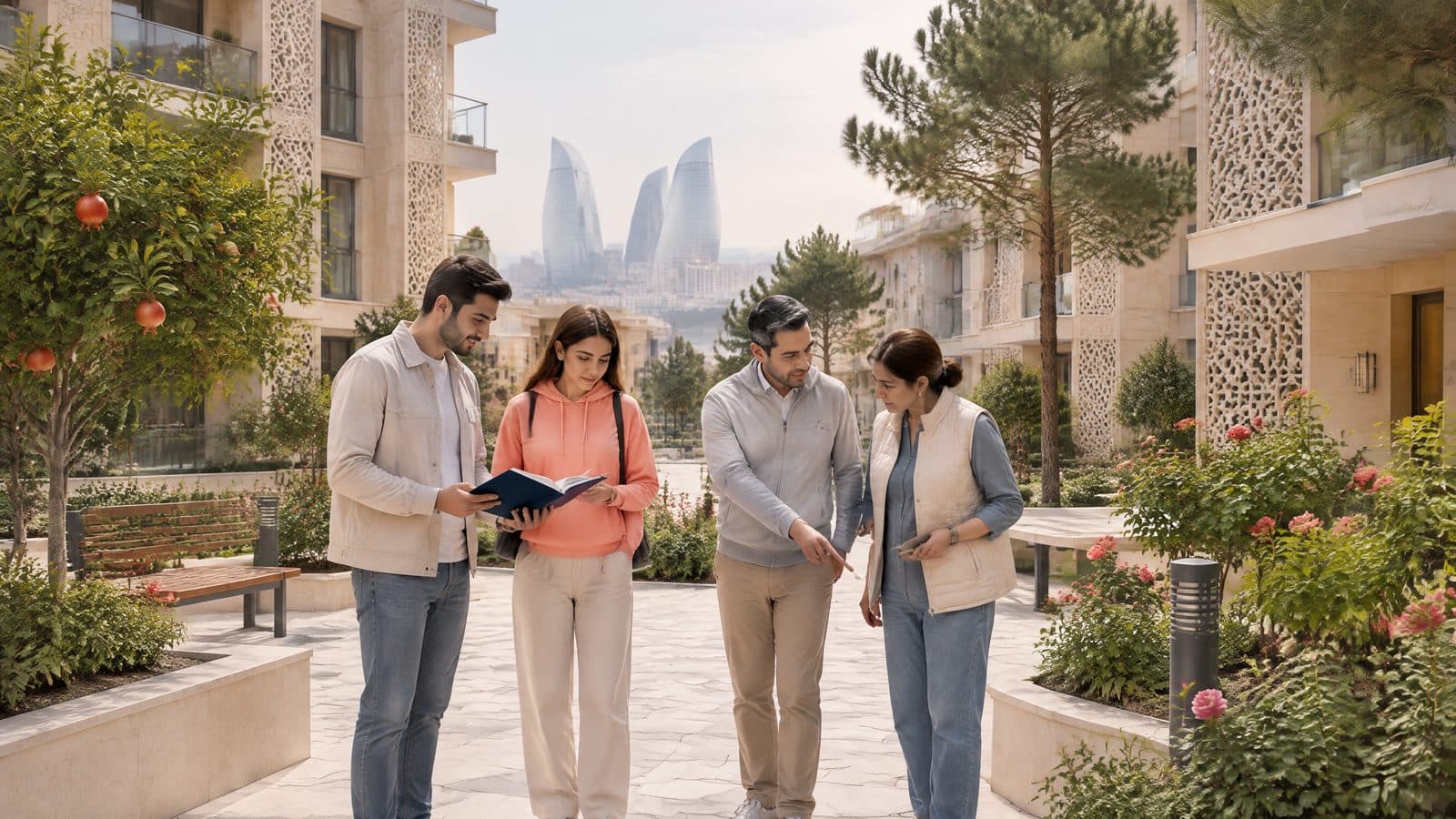
Azerbaijan's Housing Code was adopted on 30 June 2009 and has been in force since 1 October 2009. Chapters VI, XIII, XIV and XV cover multi-apartment buildings: common property and the general meeting, the owners' association (MMMC), the charges for housing, and the management of the building. Below is an overview of the key provisions with article numbers. The official text is in Azerbaijani; the wording here is ours and is not an official translation.
Which law, and in which version
The Code was approved by Law No. 845-IIIQ of 30 June 2009, published in the Legislation Collection on 31 August 2009 and has applied since 1 October 2009. This overview follows the consolidated text of 26 December 2025, published on e-qanun.az. A later amendment of 2026 concerns housing in the liberated territories and does not touch the chapters on multi-apartment buildings. The Code changes, so open the text in force before you decide anything.
Three forms of managing a multi-apartment building
Owners of premises must choose one of three forms (art. 141.2):
- direct management by the owners;
- management by an owners' association (MMMC) or a specialised consumer cooperative;
- management by a managing organisation.
The general meeting chooses and may change the choice at any time; the decision binds every owner (art. 141.3). A building may be managed by only one managing organisation (art. 141.10).
If the owners choose nothing. After six months the municipality must convene a meeting of the owners (art. 141.4), and after a year it must run an open competition for a managing organisation (art. 141.5). The competition rules were approved by Cabinet of Ministers Decision No. 128 of 1 July 2010. The owners must sign a contract with the winner (art. 141.6), and any owner may go to court to compel the competition (art. 141.8). The municipality does not manage the building itself.
The managing organisation is a legal person or a sole trader, whatever its organisational form (art. 137.3). Managing a building is not on the lists of licensed activities, and the Code introduces no certification of managers: municipalities only help with training (art. 145.1).
The owners' general meeting
- What it is. The general meeting is the building's management body (art. 43.1). Its competence includes reconstruction of the building and repair of the common property, the limits of use of the land plot, giving common property into use, choosing the management form and other matters the Code assigns to it (art. 43.2). Any owner may convene it (art. 44.2).
- Quorum. The meeting is competent when owners holding more than 50% of all votes attend, in person or by representative (art. 44.3). The Code provides no reduced quorum for a repeat meeting: without a quorum the meeting has to be held again.
- Thresholds. Reconstruction, repair of the common property, land-use limits and giving common property into use need at least two thirds of all votes; other decisions, including the choice of the management form, pass by a majority of the votes present (art. 45.1). Votes are proportional to the share in the common property (art. 47.3). Decisions bind owners who did not vote (art. 45.5).
- Notice. At least ten days before the meeting: by registered post, against signature, or by posting in a place accessible to all that the meeting has designated; the meeting may also resolve on another method (art. 44.4). The notice names the initiator, the form (meeting or absentee vote), the date, place and time, the agenda and how to see the materials (art. 44.5). Matters outside the agenda are not decided (art. 45.2).
- Absentee voting. It exists: owners send written decisions to the address in the notice (arts. 46.1 and 47.5). The decision names the voter, the document proving title and "for", "against" or "abstain" on each item (art. 46.3). The Code provides no electronic voting.
- Minutes and results. Decisions are recorded in minutes in the form the meeting itself decides (art. 45.1). The initiator communicates the results to owners within ten days by posting them in an accessible place (art. 45.3), and the minutes are kept where the meeting decides (art. 45.4). An owner who did not take part or voted against, and whose rights are violated, may challenge the decision in court within six months (art. 45.6).
A template in Azerbaijani: minutes of the general meeting and an absentee-vote sheet.
The owners' association (MMMC)
In Azerbaijan the owners' association is called mənzil mülkiyyətçiləri müştərək cəmiyyəti, abbreviated MMMC. It is a voluntary union of owners and a non-commercial legal person (arts. 119.1 and 119.2). Do not confuse an MMMC with an MMC, which is a limited liability company.
- Creation. The general meeting decides: owners with more than 50% of all votes must vote for it, and the founders' own votes must also exceed 50% (arts. 120.1 and 119.4). A building may have only one MMMC (art. 120.3). It becomes a legal person on state registration (art. 119.6).
- Organs. The general meeting of participants, the board and an audit commission or auditor (art. 124). The board has at least three members elected for up to two years, and it elects its chair from among them (arts. 127.3 and 127.4). The chair acts without a power of attorney and signs payment documents (art. 129.2).
- Reporting. The board monitors timely payment and prepares the annual estimate and financial report for the meeting (arts. 128.0.2 and 128.0.3). The audit commission audits the finances at least once a year (art. 130.3.1).
- Funds. A reserve fund and a repair fund are created only by a decision of the meeting, and the Code requires no compulsory reserve (arts. 125.2.5 and 131.3).
MTK. The abbreviation "MTK" is not in the Code: it speaks of a mənzil-tikinti kooperativi, a housing-construction cooperative that builds a building and manages it for a time (art. 109.1). Once construction is complete and more than half of the premises have passed to its members, within a month a decision must be taken to liquidate the cooperative or convert it into an MMMC (art. 109.5). In Baku speech "MTK" more often means the company that runs a new building. More: MTK nədir (in Azerbaijani).
The monthly charge
An owner's bill has two parts: the charge for maintenance and repair of the premises, which includes managing the building, maintaining the common property and current and capital repair, and the charge for utilities (arts. 136.2 and 136.2.1). In the Code utilities are cold and hot water, sewerage, electricity, gas and heat (art. 136.4).
- Deadline. Unless the management contract says otherwise, the charge for a month is paid by the 15th of the following month, on payment documents presented by the 5th (art. 137.1).
- A change in the amount. Unless the contract provides another term, the managing organisation notifies a change in the amount 30 days before the first document with the new sum, stating the legal grounds (art. 137.11).
- Who sets the amount. Where no MMMC or cooperative exists, the general meeting sets the maintenance and repair charge for at least a year and owners pay the managing organisation (arts. 138.4 and 137.6). Where an MMMC exists, its organs set the mandatory payments under its charter (art. 138.5). If the meeting takes no decision, the competent executive authority sets the amount (art. 140.3). The Code sets no national tariff for maintaining a building and no minimum charge.
- An empty flat and a sale. Not using a flat is no ground for not paying (art. 137.10). Capital-repair obligations pass to the new owner with the flat (art. 140.2); the Code does not say this of ordinary maintenance arrears.
- Information on request. Municipalities and managing organisations must, on a citizen's request, give the amount of the charge and the list and quality of services and works (art. 145.3). The Code does not oblige them to publish this.
The management contract
Article 142 governs the management contract:
- written form, one document signed by the parties; where the meeting chooses a managing organisation, the contract is concluded with each owner on the terms in the meeting's decision (art. 142.1);
- mandatory content: the composition of the common property and the building's address, the list of services and works and how it is changed, the list of utilities, the contract price and how the charge is determined and paid, how performance is monitored, and the provisions the Code requires to be included (art. 142.3);
- the same terms for all owners; the charge differs only in proportion to the area and the utilities actually used (art. 142.4);
- a term of at least one and at most five years, and at most three where the contract follows the competition (art. 142.5); if nobody applies to terminate, the contract is treated as extended on the same terms (art. 142.6);
- performance begins within 30 days unless the contract says otherwise (art. 142.7);
- unilateral termination by the owners: under a contract concluded after the competition, on each anniversary provided the meeting decides on the form of management (art. 142.9), and when the managing organisation breaches the contract, by decision of the meeting (art. 142.10);
- 30 days before the contract ends the managing organisation hands the building's technical documents to the new organisation, the MMMC, the cooperative or the named owner (art. 142.12);
- unless the contract says otherwise, the managing organisation reports to owners in the first quarter of each year for the previous year (art. 142.13).
A template in Azerbaijani: management contract.
What the Code does not provide
- electronic voting or an online meeting: an absentee decision is written (arts. 46.1 and 47.5);
- a duty to open a separate bank account for the building or to pay only cashless: the bank accounts in the Code are the MMMC's own (arts. 119.6 and 131.4);
- statutory interest on late payment;
- certification or licensing of managers (art. 145.1);
- a compulsory reserve fund (arts. 125.2.5 and 131.3);
- a duty on the seller to tell the buyer about unpaid charges: only capital-repair obligations pass to the buyer (art. 140.2).
Komendant pulu
In Baku people call the monthly building maintenance charge collected by the superintendent, the MTK or the manager "komendant pulu". The Code does not know the word: the monthly charge is called the charge for maintenance and repair of the premises, and it includes managing the building (art. 136.2.1). The amount is set by the general meeting or the organs of the MMMC (arts. 138.4 and 138.5), and the managing organisation must give a breakdown on request (art. 145.3). As of 10 September 2026 there is no adopted law abolishing this charge. Reports of abolition are not yet law: until a change is adopted and published, the current rule applies. Check the text in force on e-qanun.az. More: Komendant pulu nədir, qanunidirmi, ləğv olunurmu (in Azerbaijani).
What Unitify does
The Code does not require software, and Unitify does not replace it. For managing organisations and MMMCs in Azerbaijan, Unitify calculates the charge per premises, shows the payment document in the resident's app, and tracks payments and debt; the app also works in Azerbaijani. Card payment runs through Yigim, and other methods are connected on request in 1 to 2 days. Unitify does not set the amount of the charge and does not replace accounting: the amount is set by the meeting or the organs of the MMMC.
More for managers: Unitify in Azerbaijan.
Source: Housing Code of the Republic of Azerbaijan of 30.06.2009, consolidated text of 26.12.2025, e-qanun.az/framework/46955, arts. 43, 44, 45, 46, 47, 109, 119, 120, 124, 125, 127, 128, 129, 130, 131, 136, 137, 138, 140, 141, 142, 145; Cabinet of Ministers Decision No. 128 of 01.07.2010, e-qanun.az/framework/19802. Checked on 10 September and 8 October 2026. The Code changes: open the text in force before you decide. The wording is ours and is not an official translation.
Sources
Frequently asked questions
Is there an official Russian or English translation of Azerbaijan's Housing Code?
The official text is written in Azerbaijani and published on e-qanun.az. We do not give a full translation: this article is our overview of the provisions on multi-apartment buildings, with article numbers. The wording is our own and is not an official translation.
When did Azerbaijan's Housing Code enter into force?
The Code was adopted on 30 June 2009, approved by Law No. 845-IIIQ and has been in force since 1 October 2009. This overview follows the consolidated text of 26 December 2025.
What forms of management does the Code provide for a multi-apartment building?
Three: direct management by the owners, management by an owners' association (MMMC) or a specialised consumer cooperative, and management by a managing organisation. The general meeting chooses, the decision binds every owner, and a building may have only one managing organisation (arts. 141.2, 141.3 and 141.10).
What quorum does an owners' general meeting need in Azerbaijan?
The meeting is competent when owners holding more than 50% of all votes attend, in person or by representative (art. 44.3). The Code provides no reduced quorum for a repeat meeting. Decisions pass by a majority of the votes present, while reconstruction, repair of the common property, land-use limits and giving common property into use need two thirds of all votes (arts. 43.2 and 45.1).
When is the building charge due in Azerbaijan?
Unless the management contract says otherwise, the charge for a month is paid by the 15th of the following month, on payment documents presented by the 5th (art. 137.1). A change in the amount is notified 30 days before the first document with the new sum, unless the contract provides another term (art. 137.11).
What is "komendant pulu" in Baku, and has it been abolished?
It is what people call the monthly building charge. The Code does not use the word: the charge for maintenance and repair includes managing the building (art. 136.2.1), and its amount is set by the meeting or the organs of the MMMC (arts. 138.4 and 138.5). As of 10 September 2026 there is no adopted law abolishing it.
How does an MMMC differ from an MTK?
An MMMC is an owners' association, a voluntary union of the owners of premises (art. 119.1). The abbreviation "MTK" is not in the Code, which speaks of a housing-construction cooperative that builds a building and manages it for a time (art. 109.1). In Baku speech "MTK" often means the company that runs a new building.