
Kazakhstan ОСИ Targeted Contribution: Who Decides
The roof leaks, the lift needs replacing, the yard needs a barrier. The current account is short, and the accumulative contribution is spent on capital repair and only by a decision of the assembly. Then someone in the chat writes: "let's collect a targeted contribution." After that the confusion starts. Who decides this? Can anyone be made to pay? From which day is it a debt? Here is what the law says on the subject and what it does not.
Paying is mandatory, collecting is not
The most common mistake is to treat the targeted contribution as voluntary. The law says the opposite. Owners of apartments and non-residential premises must pay current, accumulative and targeted contributions (art. 34-1, para. 1 of the Law "On Housing Relations"). Owners of parking spaces and storage rooms must pay the current contributions for their upkeep, as well as the accumulative and targeted contributions.
What is optional is something else: the levy itself. The decision to collect targeted contributions, their amount, deadlines and other terms is taken at the assembly (art. 34-1, para. 4). Until the assembly has decided, there is nothing to collect. Once it has, everyone must pay.
If you need one sentence for the notice board: the assembly decides whether to introduce the contribution, and after the decision it is mandatory.
Who decides: the assembly, not the chairman
Deciding on the collection of targeted contributions, their amount, deadlines and other terms of payment is a matter for the assembly (art. 42, para. 5, sub-para. 10). The chairman of the ОСИ does not take this decision alone. The chairman's job is different: to organise the assembly and to carry out its decisions (art. 51-1, para. 5, sub-paras 4 and 7).
There is one more rule worth knowing. Additional expenses that do not belong to the expenses of managing the condominium object cannot be placed on owners without an assembly decision (art. 34-1, para. 5). So "the chairman agreed, everyone chipped in" does not work. There has to be a protocol: see the model ОСИ assembly protocol (in Russian), built on the forms of order No. 358.
Write into the protocol what the law lists: the decision to collect, the amount, the deadlines and the other terms of payment. The assembly sets the deadline of a targeted contribution (art. 34-1, para. 4). Para. 8 names the "by the 25th of the following month" deadline for current and accumulative contributions. But para. 9 charges penalty interest on targeted contributions "starting from the day after the one established in para. 8". The provision does not say how this fits a deadline set in the protocol. Before setting a date later than the 25th, check with a lawyer.
How many votes it takes
The wording matters here. The assembly may decide if more than half of the total number of owners of apartments and non-residential premises take part. A decision passes with the consent of a majority of those who voted, except for the matters in sub-paras 6)-16) and 21) of art. 42, para. 5. For those, the consent of a majority of the total number of owners is needed (art. 42, para. 8).
The decision to collect targeted contributions is sub-para. 10. It falls within 6)-16). So the majority is counted from the total number of owners, not only from those who showed up. If a building has one hundred owners and sixty voted, more than fifty must vote in favour.
A targeted contribution for one entrance
There is a separate rule for the case when a repair is not needed by the whole building. Owners of apartments and non-residential premises of one entrance may decide to collect targeted contributions to pay for measures not provided for in the annual estimate of expenses for managing the condominium object, if this does not affect the interests of the owners of other entrances. The decision is considered adopted with the consent of more than two thirds of the total number of owners of that entrance, with a protocol drawn up (art. 42, para. 11).
One caveat. The route to a notary or to court in art. 34-1, para. 10 is named for the contributions under sub-paras 7), 8), 9), 10) and 11) of art. 42, para. 5. An entrance-level decision under art. 42, para. 11 is not named in that list. So if you plan to collect a debt on such a contribution, talk to a lawyer first.
What if they do not pay
For a targeted contribution the law says three things.
- Late payment attracts penalty interest from the day after the para. 8 deadline, in accordance with the legislation of the Republic of Kazakhstan. The provision names no rate (art. 34-1, para. 9), so do not take a figure from there.
- The limitation period does not apply to a claim to repay this debt (art. 34-1, para. 9).
- If the owner has not repaid the debt, the chairman of the ОСИ or the management subject may turn to a notary or to court after two months from the established payment date (art. 34-1, para. 10).
Read the third point carefully: the word is "may". It is an option, not a duty. And the two months run from the established payment date, so the payment date must be written into the protocol precisely.
Where the money goes and what owners see
The law puts it this way: "Targeted contributions are credited to the current account of the association of property owners or of the management subject of the condominium object where the owners of apartments and non-residential premises have chosen direct joint management as the form of managing the condominium object" (art. 34-1, para. 4; our translation). How to read this qualification for an ОСИ is not stated in the provision quoted. Ask a lawyer and check your charter.
After that the usual reporting applies. The chairman of the ОСИ ensures monitoring of the owners' payment of current, accumulative and targeted contributions (art. 51-1, para. 5, sub-para. 11). The monthly report on managing the condominium object goes out by the twentieth of the month following the reporting period, and the annual report by 1 April. The reports must show additional expenses that do not belong to management expenses (art. 46, para. 1). The approved form of the monthly report has separate lines for targeted contributions that were not included in the annual estimate.
Where Unitify helps
The decision to collect belongs to the assembly, and an app cannot replace it. An app does not by itself make an assembly legally valid. But it makes the routine around the decision easier.
Voting. In Unitify you can create a "Meeting", pick the building and the voting period, and publish it. Residents answer from their phone in the resident app, and you see how many apartments have voted.
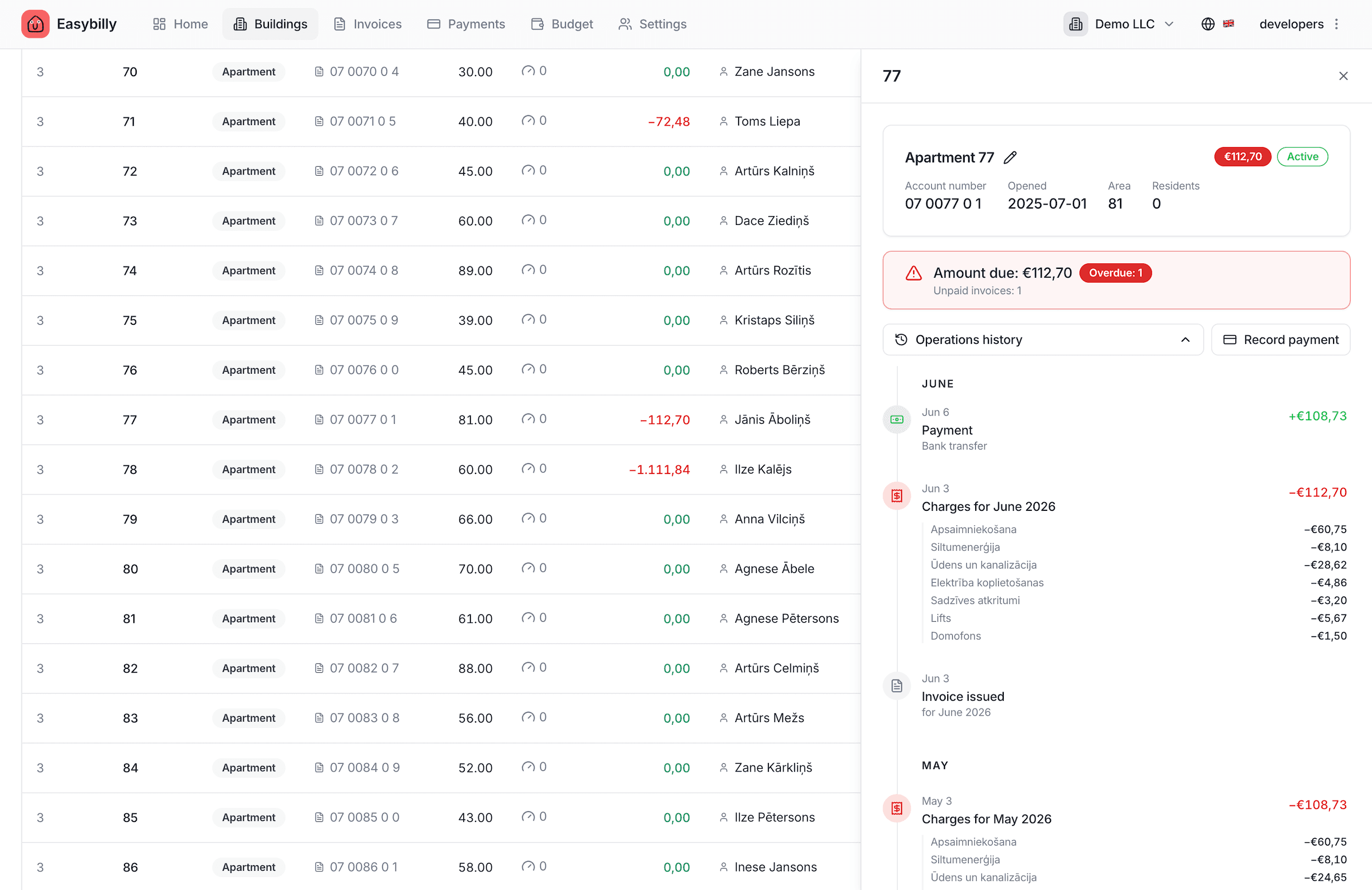
Charging. Easybilly, Unitify's billing module, calculates charges by the rules of the building: per square metre, per apartment, per resident or as a fixed amount. The receipt goes to the resident app, every line shows where the amount came from, and it can be paid by QR code or in the app. In the charges register an apartment's charges, payments and receipts sit next to the balances of the whole building.
You take the amount of the contribution, the deadline and the wording of the decision from the protocol, not from the software. Easybilly does not replace accounting.
To see what it looks like for your building, you can start free on the Unitify page for ОСИ in Kazakhstan.
Source: Law of the Republic of Kazakhstan "On Housing Relations", art. 34-1 (paras. 1, 4, 5, 8-10), art. 42 (para. 5, 8, 11), art. 46 (para. 1), art. 51-1 (para. 5), adilet.zan.kz, accessed 07.09–01.10.2026; art. 42 para. 11 re-read 11.10.2026.
Frequently asked questions
Is paying the targeted contribution in an ОСИ mandatory?
Yes. Owners of apartments and non-residential premises must pay current, accumulative and targeted contributions (art. 34-1, para. 1 of the Law on Housing Relations). What is not mandatory is the levy itself: the decision to collect targeted contributions, their amount, deadlines and other terms is taken at the assembly (art. 34-1, para. 4). Once the assembly has decided, payment is due.
Who decides how much to collect and by what date?
The assembly. The decision to collect targeted contributions, their amount, deadlines and other terms is taken at the assembly (art. 34-1, para. 4). In the list of assembly matters this is sub-para. 10 of art. 42, para. 5. You write the payment deadline of the targeted contribution into the protocol yourselves.
How many votes does it take to levy a targeted contribution?
The assembly may decide if more than half of the total number of owners of apartments and non-residential premises take part. A decision passes by a majority of those who voted, but for the matters in sub-paras 6)-16) and 21) of art. 42, para. 5 the majority of the total number of owners is needed (art. 42, para. 8). The decision to collect targeted contributions is sub-para. 10, which falls within 6)-16).
What happens if an owner does not pay the targeted contribution?
Late payment of targeted contributions attracts penalty interest in accordance with the legislation; the provision itself names no rate, and the limitation period does not apply to a claim to repay the debt (art. 34-1, para. 9). Two months after the established payment date the chairman of the ОСИ or the management subject may turn to a notary or to court (art. 34-1, para. 10). That is a right, not a duty.