
Sondereigentum and Gemeinschaftseigentum: The Difference Under the WEG
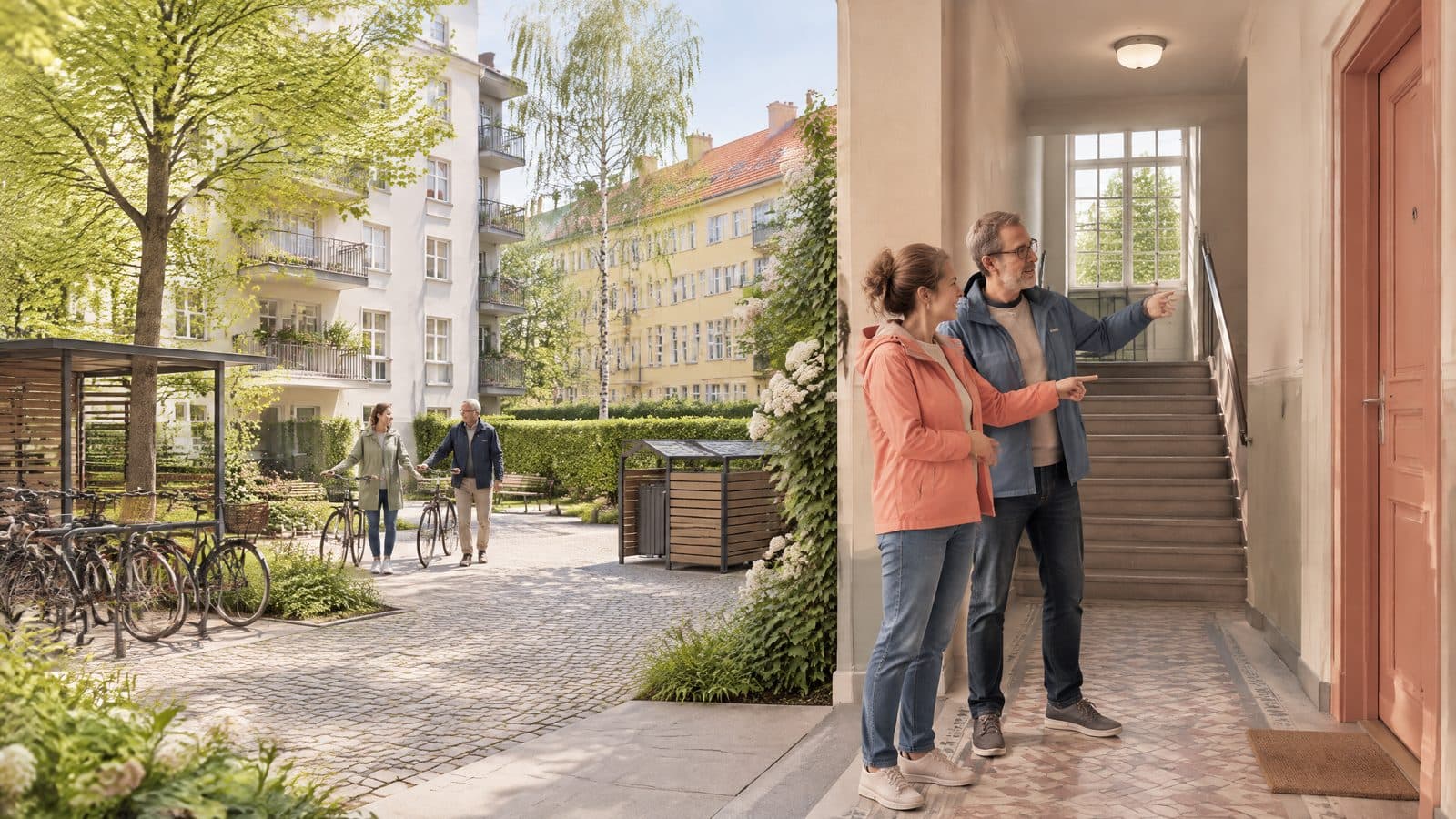
The difference between Sondereigentum and Gemeinschaftseigentum usually matters because of a concrete problem. A window sticks. The balcony has cracks. And someone asks the Hausverwaltung: is this ours, or the community's? The answer comes in two parts. The Act gives a clear test. It contains no list of building components.
The basic terms in sections 1 and 3 WEG
Wohnungseigentum is the Sondereigentum in a flat combined with the co-ownership share in the common property to which it belongs (section 1(2) WEG). Teileigentum is the same for rooms not used for residential purposes (section 1(3) WEG). So in Wohnungseigentum, Sondereigentum and co-ownership share are linked.
The Act defines common property backwards: it is the plot and the building so far as they are not Sondereigentum or owned by a third party (section 1(5) WEG). What is neither Sondereigentum nor a third party's property is therefore common property.
Sondereigentum comes into being in two ways. The first is a contract of the co-owners: under section 3(1) WEG the co-ownership of a plot can be restricted so that each co-owner is granted ownership of a specific flat or of specific rooms not used for residential purposes. The second is division by the owner: under section 8(1) WEG the owner of a plot may divide the ownership by a declaration to the land registry into co-ownership shares, each of which is tied to Sondereigentum. For the second way, practice says Teilungserklärung. The word is not in the Act. Under section 8(2) WEG the rules on parking spaces and on parts of the plot outside the building (section 3(1) sentence 2, (2) and (3)) apply accordingly to this way.
The test in section 5 WEG
Which building components belong to the rooms? Here the Act gives no list, but two subsections that must be read together.
Section 5(1). The subject of Sondereigentum is the rooms and those components of the building belonging to these rooms which can be changed, removed or added without thereby impairing the common property or another owner's right based on Sondereigentum beyond what is unavoidable in orderly coexistence, or altering the external appearance of the building.
Section 5(2). Parts of the building that are necessary for its existence or safety, and installations and facilities that serve the owners' common use, are not the subject of Sondereigentum. That applies even if they are located within the rooms or parts of the plot that are Sondereigentum.
Subsection 2 is mandatory. What is necessary for the building's existence or safety does not become Sondereigentum just because it lies inside your flat.
One detail often overlooked: section 5(3) lets the owners move the line in one direction. They may agree that components that could be the subject of Sondereigentum belong to the common property. There is no mirror-image rule.
Balcony and windows: what the Act says and what it does not
The WEG has no sentence that classifies a balcony or windows. The Act contains no list of building components, only the test from section 5(1) and (2). Whether a particular window, balcony or door lies on one side of the line or the other therefore cannot be read off a list. It depends on what your Teilungserklärung says and on how the test applies to the specific component. In case of doubt that is a question for your legal adviser, not for a rule of thumb.
A table saying "windows yes, balcony no" therefore does not exist. The statutory text contains no such assignment, and it could only be justified through case law on the individual component. Besides the test, what matters is what your Teilungserklärung provides and whether the owners have agreed under section 5(3) that a component belongs to the common property.
Parking spaces and areas outside the building
For parking spaces too the Act says something concrete. Parking spaces count as rooms within the meaning of section 3(1) sentence 1 (section 3(1) sentence 2 WEG). Sondereigentum may be extended to a part of the plot outside the building, unless the flat or the rooms not used for residential purposes thereby cease to be economically the main thing (section 3(2) WEG). And Sondereigentum is to be granted only if parking spaces and parts of the plot outside the building are defined by dimensions in the Aufteilungsplan (section 3(3) WEG).
Do not confuse: Sondernutzungsrecht
The Sondernutzungsrecht is not ownership but a right of use. The WEG mentions it in section 5(4) sentence 2 and does not define it there. If your documents say "Sondernutzungsrecht", it is not Sondereigentum.
Where Unitify fits
For property managers: Unitify replaces neither the Teilungserklärung nor legal advice. Your billing stays; Unitify is the layer for owners above it: notices, requests with status and votes in the resident app. Hausgeld and the annual statement stay in your software.
The use shows in exactly the question from the introduction. When an owner reports a window or a balcony, they can submit the request in the app and follow it until it is closed. That still does not settle on which side of the line the component lies. That remains a question for your documents and your legal adviser.
You can start free on the Unitify page for Germany.
Sources: WEG section 1 (subsections 2, 3 and 5), section 3 (subsections 1 to 3), section 5 (subsections 1 to 4) and section 8 (subsections 1 and 2), gesetze-im-internet.de, accessed 21 September 2026.
Frequently asked questions
What is the difference between Sondereigentum and Gemeinschaftseigentum?
Common property is the plot and the building so far as they are not Sondereigentum or owned by a third party (section 1(5) WEG). Sondereigentum is the rooms and the building components belonging to them that can be changed, removed or added without impairing the common property or other owners' rights beyond the unavoidable and without altering the building's external appearance (section 5(1) WEG).
Is there a list of what is Sondereigentum and what is Gemeinschaftseigentum?
Not in the WEG. The Act gives a test in section 5(1) and (2), but no list of building components. Anyone offering a list is not relying on the statutory text.
Are the balcony and the windows Sondereigentum or Gemeinschaftseigentum?
The WEG contains no list of building components; the test of section 5(1) and (2) applies. Accordingly: parts of the building that are necessary for its existence or safety are not the subject of Sondereigentum, even if they are within the rooms that are Sondereigentum (section 5(2) WEG). Whether a specific component falls under that, and what your Teilungserklärung provides, is a question for your legal adviser.
Can parking spaces be Sondereigentum?
They can. Parking spaces count as rooms within the meaning of section 3(1) sentence 1 WEG (section 3(1) sentence 2). Sondereigentum is to be granted only if parking spaces are defined by dimensions in the Aufteilungsplan (section 3(3) WEG).