
Vienna Bauwerksbuch: Duty, Deadlines and Penalties
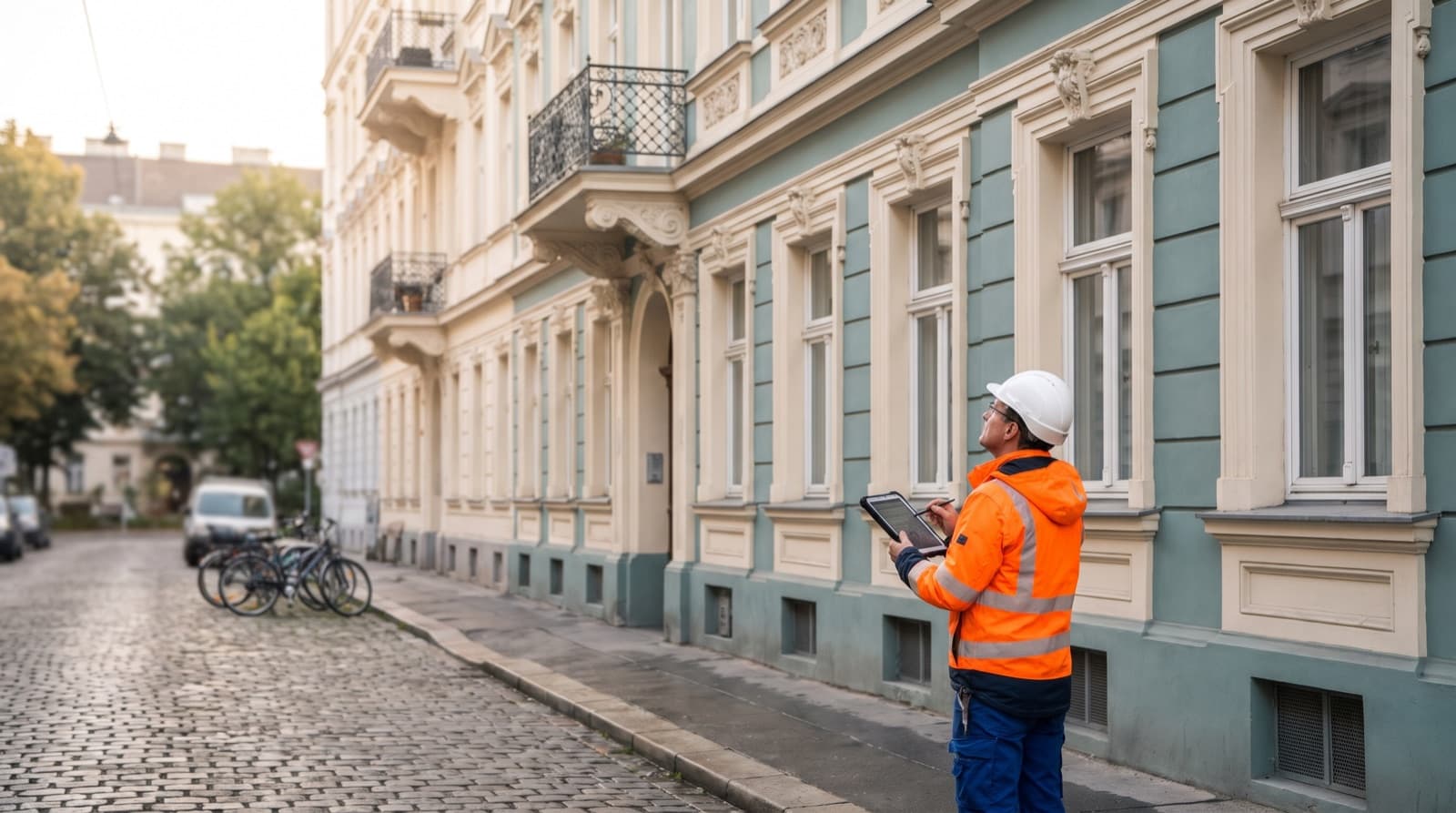
Duty, deadlines, penalties, single-family house: these are the questions asked most often about the Vienna Bauwerksbuch. The answers are in the Vienna Building Code (Bauordnung für Wien), though not everywhere you might expect. The legal basis is Section 128a, readable in full on RIS. This is Vienna state law, not a nationwide Austrian law: it applies within Vienna and not automatically in other states. The statute text was last checked on 27 October 2026 (version in force from 15 July 2026).
What goes into the Bauwerksbuch is covered in Vienna Bauwerksbuch: Template and Sample Outline to Download. Who may prepare it and what drives the effort is in Vienna Bauwerksbuch: Preparer and Cost Drivers.
Who is obliged?
Under Section 128a(1), the owner (or co-owners) of a building must have a Bauwerksbuch prepared and the inspections it provides for carried out on time. These concern components whose deterioration may endanger life or health, "in particular load-bearing structures, building envelope, railings and parapets".
The owner must have it prepared by an independent party: a civil engineer (Ziviltechniker), a court-sworn expert for the relevant field, or a person entitled under the professional rules (subsection 2). For existing buildings, Section 128c(2) point 2 requires the electronically signed confirmation of such a preparer.
With a property manager: under subsection 5 the Bauwerksbuch is kept in electronic form by the owner, or by the property manager where one is appointed, and made available to the authority on request. The duty to have it prepared stays with the owners; the ongoing electronic keeping passes to the Hausverwaltung.
The deadlines
- New builds, additions and conversions: the Bauwerksbuch must exist by the time the completion notice is filed (subsection 2).
- Existing buildings erected before 1 January 1919: by 31 December 2027 (subsection 3, point 1).
- Existing buildings erected between 1 January 1919 and 1 January 1945: by 31 December 2030 (subsection 3, point 2).
- Registration: the Bauwerksbuch of an existing building is registered in the Bauwerksbuch database from 1 July 2024 (subsection 3, Section 128c). Section 128c(2) requires the date of preparation, the electronically signed confirmation from the preparer, the date of the first inspection and the inspector's confirmation to be submitted.
- Buildings after 1 January 1945: Section 128a(3) names no deadline for these. The duty can still arise on a new build, addition or conversion (subsection 2), or because the authority "in justified cases" orders the owner to have a Bauwerksbuch prepared "within a reasonable period" (subsection 3).
For an existing building, a first inspection must also be carried out in the course of preparation, by a person from the same list who is different from the applicant, the builder and the owner (subsection 3).
Does it apply to a single-family house?
Section 128a speaks of "buildings". The word "Einfamilienhaus" does not occur in the section, and there is no separate exemption for single-family houses. Only these are exempt (subsections 2 and 3):
- allotment-garden houses (Kleingartenhäuser),
- allotment-garden residential houses (Kleingartenwohnhäuser),
- buildings with a built-up area of not more than 50 m².
A single-family house in Vienna therefore falls under Section 128a unless it meets one of those three exemptions. The deadline depends on the year of construction: a pre-1919 house has until 31 December 2027, a house from 1919 to 1945 until 31 December 2030. For a single-family house built after 1945 the statute names no deadline, but an addition or conversion can trigger the duty (subsection 2). Whether the built-up-area exemption applies to your house depends on the actual area, not on calling the house "small".
Penalties: what the Building Code says and what it does not
Section 128a itself names no penalty and no amount, and does not refer to Section 135. The Vienna Building Code does have a general penalty provision, Section 135 ("Baustrafen"). From it:
- Section 135(1): violations of the Act and of ordinances issued under it are punishable by "a fine of up to EUR 50,000", with a substitute prison term of up to two weeks if it cannot be collected. That is a maximum ("up to"), not a fixed amount.
- Section 135(3): whoever by a violation causes a danger to the life or health of persons is punishable by a fine of up to EUR 300,000 or imprisonment of up to six weeks.
- Section 135(5): whoever administers a building is responsible in the owner's place for violations of the duties the Act imposes on the owner, if the act was committed without the owner's instigation and foreknowledge. The owner is responsible alongside the administrator if he failed to take due care in selecting or supervising them.
What penalty the authority would impose in an individual case for a missing or not electronically kept Bauwerksbuch cannot be read from the statute. We therefore give no figure for it. For a property manager, subsection 5 is the relevant one: it divides responsibility between manager and owner, and anyone who wants the division of tasks to be clear is best served by putting it in writing.
What you can do now
- Sort the portfolio: split buildings by year of construction into three groups (before 1 January 1919, 1919 to 1945, later) and check the exemptions.
- Gather the documents: building permits, completion notices or occupancy permits are the first content item (Section 128a(4) point 1). The template walks through all seven points.
- Commission a preparer: an independent party under subsection 2, in good time before the deadline.
- Decide on the electronic keeping: who keeps the Bauwerksbuch and how it is made available to the authority (subsection 5).
What Unitify contributes, and what it does not
Unitify keeps the building documentation a Bauwerksbuch needs, documents and a property register, current on an ongoing basis instead of collecting it under deadline pressure. Per building, documents, deadlines and responsibilities stay visible, so the 2027 and 2030 deadlines do not arrive as a surprise.
Unitify is not a Bauwerksbuch within the meaning of Section 128a and does not create one. It replaces neither the independent party that prepares the Bauwerksbuch under Section 128a(2) nor the authority that checks it, and gives no legal advice.
See the Austria page and pricing. If the deadlines for your portfolio are closer than the documents you have ready for them, book a demo.
Sources
Frequently asked questions
Is a Bauwerksbuch mandatory in Vienna?
Yes, for new builds, additions and conversions and for existing buildings erected before 1 January 1945; for later existing buildings Section 128a(3) names no deadline. Under Section 128a(1) of the Vienna Building Code the owner (or co-owners) of a building must have a Bauwerksbuch prepared and the inspections it provides for carried out on time. Allotment-garden houses, allotment-garden residential houses and buildings with a built-up area of not more than 50 m² are exempt (subsections 2 and 3).
By when must an existing building have a Bauwerksbuch?
By 31 December 2027 for buildings erected before 1 January 1919, and by 31 December 2030 for all buildings erected between 1 January 1919 and 1 January 1945 (Section 128a(3)). For buildings after 1 January 1945 Section 128a(3) names no deadline.
Does the duty apply to a single-family house in Vienna?
Section 128a speaks of "buildings" and has no exemption for single-family houses as such. The exemptions are allotment-garden houses, allotment-garden residential houses and buildings with a built-up area of not more than 50 m². A single-family house therefore falls under the duty unless it meets one of those, with deadlines by year of construction; for a house built after 1 January 1945 Section 128a(3) names no deadline.
What penalty applies if the Bauwerksbuch is missing?
Section 128a names no penalty and no amount of its own. The Building Code has a general penalty provision, Section 135: violations of the Act are punishable by a fine of up to EUR 50,000 (subsection 1); only where a violation causes a danger to the life or health of persons does a frame of up to EUR 300,000 apply (subsection 3). What penalty the authority would actually impose for a missing Bauwerksbuch is not stated in the statute.
Who is responsible when a property manager is appointed?
Where a Hausverwaltung is appointed, it keeps the Bauwerksbuch electronically (Section 128a(5)). Under Section 135(5), whoever administers a building is responsible in the owner's place for violations of the owner's duties if the act was committed without the owner's instigation and foreknowledge. The owner remains responsible alongside if they failed to take due care in selecting or supervising the manager.
Does the duty apply across Austria?
No. Section 128a is part of the Vienna Building Code, Vienna state law. It applies within Vienna and not automatically in other Austrian states.