
c-KOB: Poland's Digital Building Logbook for a Wspólnota
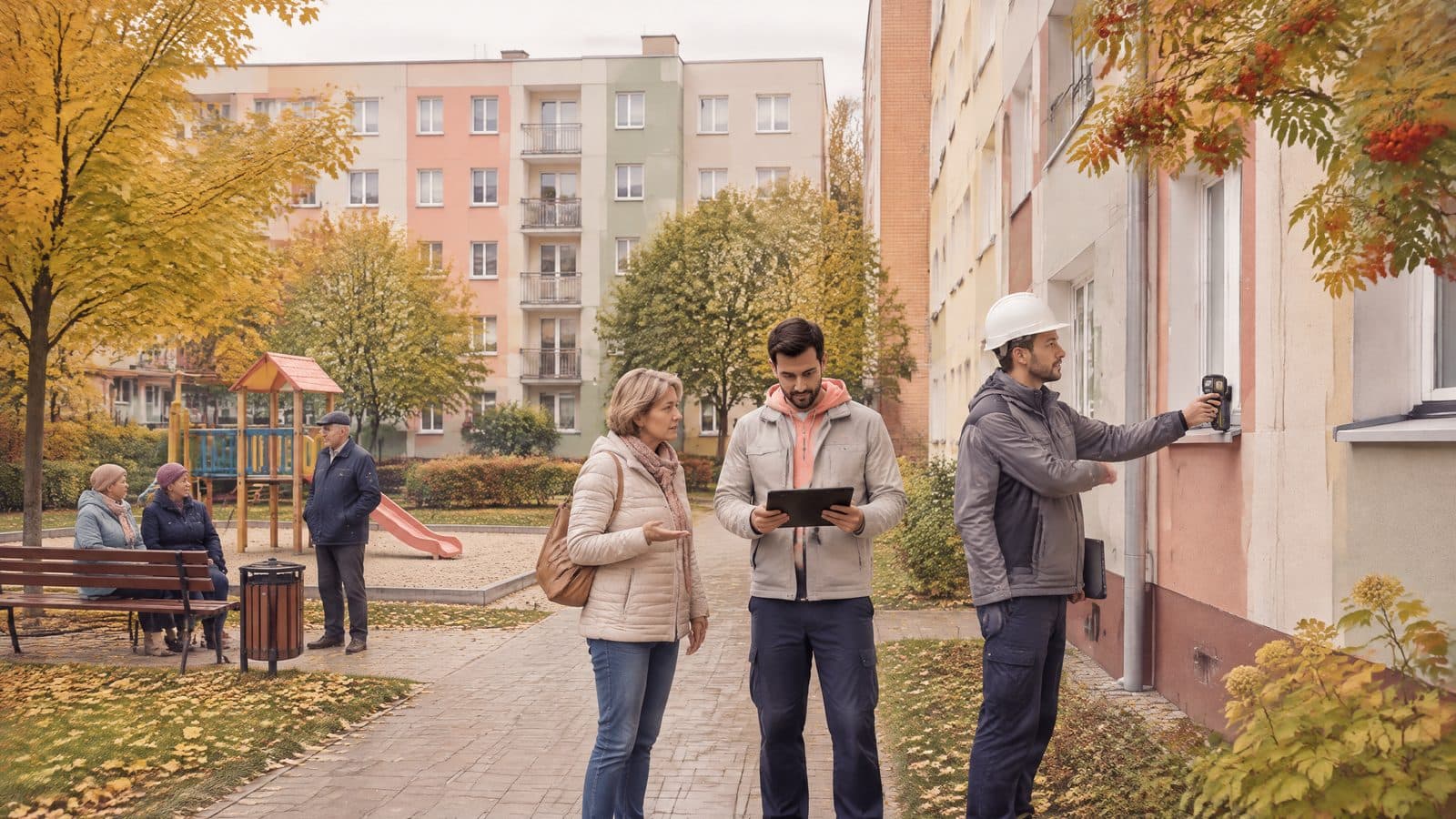
c-KOB is Poland's state system for keeping the building logbook, the książka obiektu budowlanego, in electronic form. The logbook duty covers multi-family buildings, so it covers a building run by a wspólnota mieszkaniowa (the owners' community of a condominium); it does not cover single-family houses. New books can only be opened in c-KOB, and a paper book opened before 2024 has until 31 December 2031 to move across. Article 93 of the Building Law sets a fine for failing the logbook and inspection duties, and names no amount.
Checked on 02.11.2026 against the Building Law (consolidated text Dz.U. 2026 item 524, with later changes), the amending Acts Dz.U. 2022 item 1557 and Dz.U. 2025 item 1847, and the Q&A of GUNB, Poland's Chief Office of Building Control. This is general information, not legal advice.
What the logbook and c-KOB are
The książka obiektu budowlanego records a building's inspections, expert reports, building works and official decisions (Article 60a). A digital book, an electronic book and c-KOB mean the same thing in practice: the statute speaks of a book in electronic form kept in the c-KOB system (Article 60h(1)). The system's site says opening a book is free.
Does it apply to a wspólnota?
Yes, unless the building is a single-family house. A book is kept for every building (Article 60b(1)), and single-family residential buildings are among the exemptions (Article 60b(2)). The type of building decides this, not the size of the community.
A single-family building may hold at most two flats, or one flat and one business unit (Article 3(2a)). Any other building used for housing counts as multi-family (Article 3(2c)). A community with several buildings needs a book for each.
Who acts inside a wspólnota
The Building Law never uses the word wspólnota. It places the duties on the owner or the manager (właściciel lub zarządca), so the answer comes from two statutes:
- The board (zarząd) "kieruje sprawami wspólnoty mieszkaniowej i reprezentuje ją na zewnątrz" (Article 21(1), Act on the Ownership of Units): it runs the community and represents it. More in the guide to the wspólnota and its board.
- The board, or a manager given the management in a notarial deed (Article 18(1)), takes over the technical documentation on the community's behalf. The statute names the building logbook expressly (Article 29(1b)).
- A manager on an ordinary contract acts within that contract and any authorisation given. See what a property manager does for a wspólnota.
Our reading is that the board or the Article 18 manager handles the book; no single provision says so. With three units or fewer, a board is not mandatory (Articles 19 and 20(1)), so the co-owners have to settle this among themselves.
In the system, a named person with an account does the work (Article 60j(1)). Someone acting for another party states their legal title (Article 60j(3)); GUNB says this is usually a power of attorney, and a scan is enough. Flat owners do not open their own books. GUNB: "Dla jednego obiektu prowadzi się tylko jedną książkę" (one building, one book).
From when: 2024, 2031, and where 2027 came from
- Building put into use after 1 January 2024: digital only, opened within 30 days of the occupancy permit or the effective completion notice (Articles 60c and 60h(1)).
- Paper book opened by 31 December 2023: you may keep using it (Article 6(1) and (2) of the 2022 Act), but must move to c-KOB by the end of 2031.
- Older building with no book at all: GUNB says you open a digital one. Article 6(3) speaks of those who opened a paper book, so do not count on 2031. We found no date in the legislation for this case.
The text in force today (Article 6(3) of the Act of 7 July 2022, Dz.U. item 1557, as amended), in the original Polish:
"Właściciel lub zarządca obiektu budowlanego, który założył książkę obiektu budowlanego, o której mowa w ust. 1 i 2, zakłada do dnia 31 grudnia 2031 r. dla tego obiektu książkę obiektu budowlanego w systemie Cyfrowa Książka Obiektu Budowlanego."
Many pages still say 1 January 2027. The original wording was 31 December 2026. Article 6 of the Act of 4 December 2025 (Dz.U. item 1847) changed it, with effect from 7 January 2026. GUNB's 2023 article, which still gives 2027, now opens with a warning that it "częściowo zawiera nieaktualne informacje" (is partly out of date), and GUNB's Q&A already gives 2031.
You can move earlier: the provision sets a final date.
What goes in
Article 60a lists data on the building and on the owner or manager, Article 62 inspections, expert reports and technical opinions, reviews and repairs of fire-protection equipment, building works after the building was put into use, building disasters, and decisions by public authorities.
A site plan is attached (Article 60k), along with inspection protocols, expert reports and the energy certificate, among others (Article 64(3)). Entries in c-KOB are made within 7 days of the event (Article 60f(1)). The inspector enters the inspection, also within 7 days and also in a paper book (Article 62b(1)).
Inspections do not wait for 2031
The 2031 date concerns the form of the book, not the inspections. Article 62 inspections apply today:
- at least once a year (paragraph 1(1));
- at least once every 5 years, including electrical and lightning-protection systems (paragraph 1(2));
- twice a year, by 31 May and by 30 November, where the built-up area exceeds 2,000 m² (paragraph 1(3));
- after events such as floods or fires (paragraph 1(4));
- within 3 days of a report by residents of unjustified interference in a flat (paragraphs 1(4a) and 2a).
The penalty
Article 93(8) covers missed inspections and inspection entries. Article 93(9) covers, among other things, not opening the book within the Article 60c period, not keeping it, and late entries. Both end in a fine ("podlega karze grzywny"). Articles 93 and 94 name no amount. Article 94 refers these cases to misdemeanour procedure, so on our reading the general scale of the Code of Petty Offences (Kodeks wykroczeń) applies: a fine is set "w wysokości od 20 do 5000 złotych, chyba że ustawa stanowi inaczej", that is 20 to 5,000 zloty unless a statute says otherwise (Article 24(1) of the Code; consolidated text, Dz.U. 2026 item 1372). The person named in the book answers for keeping it (Article 60d).
What to do, step by step
- See what you have: the paper book, the latest protocols, the documentation handover protocol.
- Agree who acts: board or manager, and who holds the account. The c-KOB site lists Profil Zaufany and e-dowód among the login options.
- Open the book in c-KOB: owner or manager data, building data with its map location, the document showing legal title (Article 60j(3)).
- Name the natural person who will keep the book and attach the site plan (Articles 60d and 60k).
- Close the paper book with an entry and store it (Article 6(3)). GUNB says earlier paper entries do not have to be transferred.
- Give inspectors access (Article 60m) and put the inspection dates in your calendar.
- When the manager changes, hand the book over in the system (Article 60i).
What we could not confirm
- Exactly how to enter a wspólnota in c-KOB. GUNB's Q&A does not mention communities. Ask GUNB or the district building control inspector.
- Whether an owners' resolution is needed. We found no provision requiring one; the open-ended list in Article 22(3) of the Act on the Ownership of Units does not name the book.
- What follows from missing the 2031 date alone. Article 93(9) does not name Article 6(3) of the 2022 Act.
Where Unitify helps
Unitify is not c-KOB, makes no entries in it and is not connected to it: you keep the book in the state system. We help with the work around that duty. Documents and protocols stay organised per building, and each inspection deadline can be entered as a ticket in the calendar. Resident reports run as tracked requests, and notices to owners go out from one panel. A Polish interface can be added for your project. See the Poland page.
Book a demo if you want to see this on your own buildings.
Sources
- Building Law (Prawo budowlane), unified text of the Sejm Chancellery, based on Dz.U. 2026 items 524, 605, 646, 1161
- Consolidated text of the Building Law as published, Dz.U. 2026 item 524
- Act of 7 July 2022, Article 6, unified text (Dz.U. item 1557)
- Act of 4 December 2025 amending the Building Law, Articles 6 and 13 (Dz.U. item 1847)
- Regulation on the building logbook and the c-KOB system (Dz.U. 2022 item 2778)
- Act on the Ownership of Units, unified text (based on Dz.U. 2026 item 232)
- Code of Petty Offences, consolidated text (Dz.U. 2026 item 1372)
- GUNB (Chief Office of Building Control): questions and answers on c-KOB
- GUNB: article of 28.12.2023 with its out-of-date warning
Frequently asked questions
What is c-KOB in Poland?
c-KOB (Cyfrowa Książka Obiektu Budowlanego) is the state system in which the building logbook, the książka obiektu budowlanego, is opened and kept in electronic form (Building Law, Article 60h(1)). The Chief Inspector of Building Control is responsible for it (Article 60o(1)). The system's site says opening a book is free.
Is the building logbook mandatory for a wspólnota mieszkaniowa?
Yes, unless the building is a single-family house. A book is kept for every building (Article 60b(1) of the Building Law), and single-family residential buildings are among the exemptions (Article 60b(2)). The type of building decides this, not the size of the community.
What is the deadline to move a paper book to c-KOB?
31 December 2031, under Article 6(3) of the Act of 7 July 2022 (Dz.U. item 1557) as amended by the Act of 4 December 2025 (Dz.U. item 1847). It covers paper books opened by 31 December 2023. You can move earlier.
Do all books have to be digital from 1 January 2027?
No, that date is out of date. Article 6(3) originally said 31 December 2026. Article 6 of the Act of 4 December 2025 replaced it with 31 December 2031, with effect from 7 January 2026. The 2023 article by the building control office that still gives 2027 now carries a warning that it is partly out of date.
Who opens the book in a wspólnota, the board or the manager?
The Building Law says the owner or the manager and never mentions a wspólnota. Under the Act on the Ownership of Units, the board runs the community and represents it (Article 21(1)), and the board or a manager appointed under Article 18(1) takes over the logbook on its behalf (Article 29(1b)). We read this to mean that one of those two acts. No provision explains how to enter a wspólnota in the system.
Do old paper entries have to be copied into c-KOB?
According to the building control office, no. You close the paper book with an entry and store it (Article 6(3) of the 2022 Act), and the c-KOB book continues from it.
What is the penalty for not having a building logbook?
Article 93(8) and (9) of the Building Law provide for a fine, among other things for not opening the book within the Article 60c period, not keeping it, late entries and missed Article 62 inspections. Those provisions name no amount. Article 94 sends such cases to misdemeanour procedure, so on our reading the general scale of the Code of Petty Offences applies: a fine of 20 to 5,000 zloty unless a statute says otherwise (Article 24(1)).
Does a small building need a logbook?
A building with three or more flats falls outside the definition of a single-family building, so yes (Article 3(2a) and (2c) of the Building Law). A building with two flats may qualify as single-family and then be exempt, if it meets the whole definition.