
A Residential Developer's Marketing Stack in 2026: From Ad Analytics to the First Day After Handover
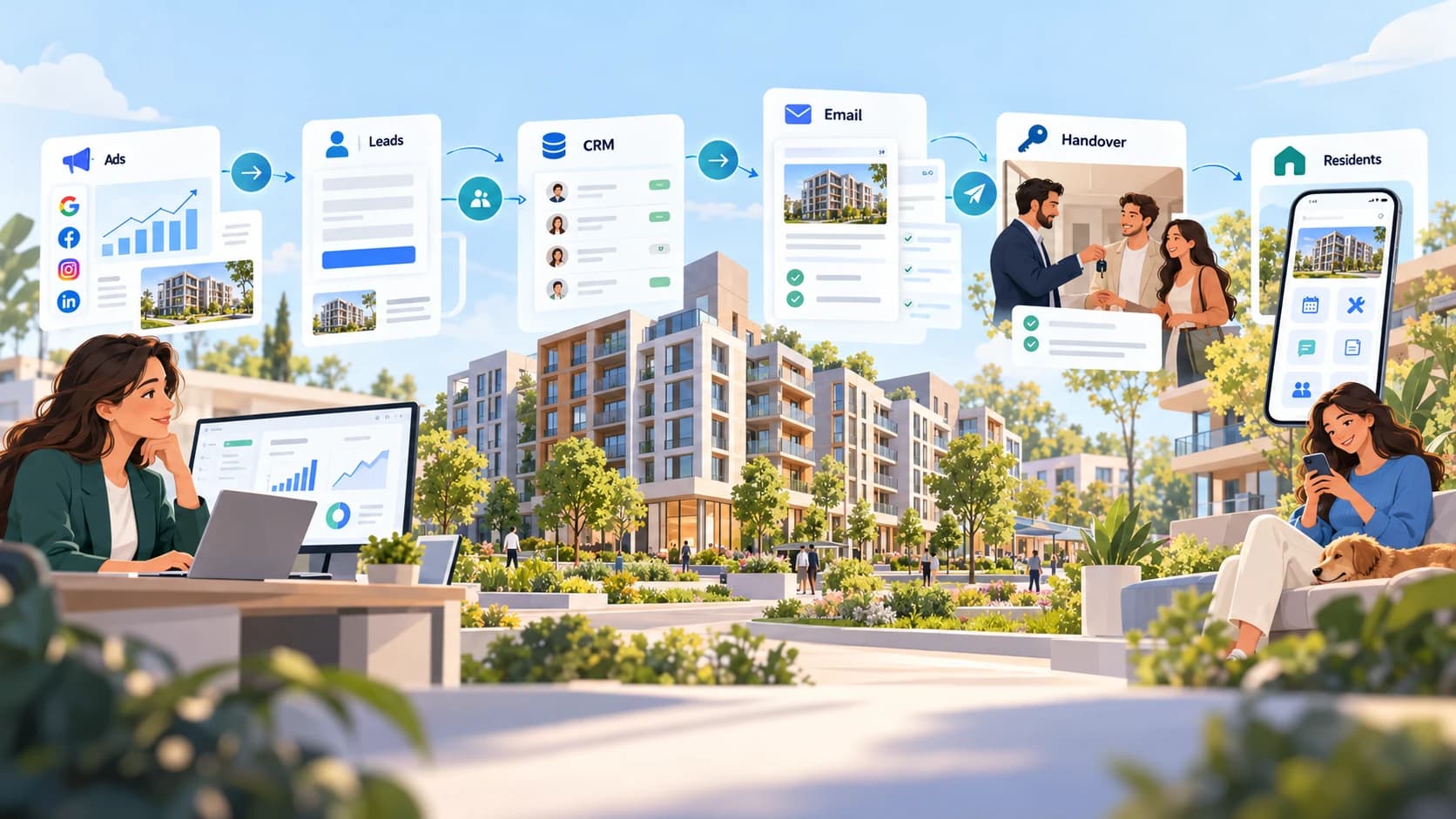
How to connect advertising, lead management, buyer emails and post-sale services without losing the customer relationship between systems.
A residential developer's marketing stack needs to do more than generate leads. It should help the team understand which campaigns bring qualified buyers, respond to inquiries, maintain communication throughout the sales process and deliver a consistent experience after the contract is signed.
Three tools address different parts of this journey. Albato connects marketing applications, advertising data and CRM workflows. UniOne handles automated transactional and marketing emails. Unitify takes over where the sales process ends, supporting apartment acceptance, key handover, warranty requests and ongoing resident services.
The goal is not to put every function into one application. It's to connect the right systems without losing information or the buyer's trust.
Key takeaways
- A developer's marketing stack should connect advertising performance with real sales outcomes.
- Albato helps automate data transfers between advertising platforms, forms, CRMs and analytics tools.
- UniOne provides email infrastructure for personalized buyer campaigns and transactional notifications.
- A sales CRM remains the system of record for prospects, deals and apartment sales.
- Unitify supports the post-contract experience, from apartment acceptance to ongoing building management.
- Clear responsibilities and controlled integrations help prevent duplicated records and disconnected customer communication.
What does a residential developer's marketing stack include?
- Advertising: Main task: Attract potential buyers and measure campaign performance; Tools and systems: Advertising platforms and analytics
- Lead capture: Main task: Transfer inquiries into the sales pipeline; Tools and systems: Albato
- Sales management: Main task: Qualify buyers, manage deals and track conversions; Tools and systems: Developer's sales CRM
- Buyer communication: Main task: Send personalized emails, confirmations and updates; Tools and systems: UniOne
- Apartment handover: Main task: Organize acceptance, defects and keys; Tools and systems: Unitify
- Post-sale experience: Main task: Manage warranty requests, resident services and building operations; Tools and systems: Unitify
A developer does not need to replace its existing sales CRM to build this workflow. The important task is connecting each stage and defining which system owns the relevant data.
1. Ad analytics: Know which campaigns bring buyers, not just leads
Residential developments often advertise across search engines, social media, property portals and other channels.
Each platform reports its own results: impressions, clicks, form submissions and conversions.
But a marketing team needs to understand what happens after the initial inquiry.
One campaign may generate many leads who never schedule a viewing. Another may produce fewer inquiries but more qualified buyers who eventually sign contracts.
What should developers measure?
Useful metrics include:
- Cost per lead
- Percentage of leads contacted
- Qualified lead rate
- Cost per scheduled viewing
- Viewing-to-reservation conversion
- Reservation-to-contract conversion
- Cost per completed sale
Connecting these stages requires consistent campaign attribution and information about what happens inside the sales CRM.
Without that connection, marketers risk optimizing campaigns for inexpensive inquiries rather than actual sales outcomes.
2. Albato: Connect advertising, lead forms and the sales CRM
Albato is a no-code integration and automation platform that connects advertising tools, analytics applications, CRMs and other business systems.
It supports workflows involving Google Ads, Facebook advertising, Google Analytics, CRM platforms and many other applications.
For a residential developer, one of its most useful applications is automating the transfer of leads from marketing channels into the sales pipeline.
How can Albato help a developer's marketing team?
Consider a residential project running several advertising campaigns.
Potential buyers submit requests through different lead forms. Without automation, sales employees may need to export inquiries, copy contact information and check whether anyone has followed up.
Albato can connect supported lead sources with a CRM so that new inquiries are transferred automatically.
Depending on the connected applications and configuration, workflows can also:
- Send new lead notifications to sales managers
- Transfer campaign information alongside contact details
- Update records in connected systems
- Collect advertising data for consolidated reporting
- Send supported conversion events back to analytics or advertising platforms
Albato's published marketing use cases include automated lead transfers and campaign reporting. Its partners have also described using the platform to process advertising leads for real estate developers.
Does Albato replace the sales CRM?
No. Albato connects applications and automates data flows between them.
The CRM remains responsible for lead qualification, sales activity, deal stages and customer records.
Albato is especially useful when a developer already has working software but struggles with manual transfers between systems.
Best for: Developers running multiple advertising channels who need to automate lead capture, data exchange and marketing reporting.
What to consider: Available workflows depend on the supported connectors, permissions and API capabilities of each application.
3. Keep the sales CRM at the center of the buyer journey
The sales CRM should provide a reliable view of each prospective buyer and their progress toward a purchase.
For a residential developer, this can include the project of interest, apartment preferences, viewing history, reservations, contract status and communication history.
A useful CRM structure also makes it possible to distinguish a first inquiry from a qualified opportunity and a signed contract.
Why does this matter for marketing?
Suppose a buyer first clicks an advertisement, then visits the development's website, requests a viewing and signs a contract several weeks later.
If advertising data and CRM records remain disconnected, the marketing team may not be able to attribute the sale correctly.
With a consistent process for capturing campaign information and updating deal stages, marketers can evaluate campaigns using downstream results.
The exact CRM product is less important than the quality of the workflow and the team's discipline in maintaining accurate records.
4. UniOne: Automated buyer emails throughout the sales process
UniOne is an email delivery platform supporting transactional messages and marketing campaigns through SMTP and API integrations.
It offers email templates, personalization, automated sending, delivery tracking and campaign analytics.
For residential developers, email remains useful when communication needs to be detailed, documented or sent to many buyers at different stages.
Which buyer emails can be automated?
A developer could use UniOne's email infrastructure to deliver messages triggered by events in its existing systems.
Examples include:
After an inquiry: A confirmation that the request has been received, with relevant information about the residential project.
Before a viewing: An appointment reminder containing the address, meeting details and contact information.
During the sales process: Requested property information, updated materials or relevant project announcements.
After signing: A confirmation or informational message triggered by the developer's internal workflow.
Before handover: Instructions explaining the next steps, required documents and how the buyer will receive further information.
UniOne supports templates and personalized fields, allowing different messages to be generated from structured customer information.
How can developers measure email performance?
UniOne provides information about email deliveries, bounces, opens, clicks, unsubscribes and other events.
Its API and webhooks can help developers connect delivery information with their existing applications.
For example, a team can monitor whether an important email was delivered and identify addresses that consistently fail.
These metrics are useful for communication quality, although email opens alone should not be treated as proof that a buyer has read or understood a message.
Is UniOne a replacement for marketing automation or CRM?
Not entirely.
UniOne provides email delivery infrastructure and related campaign functionality. The developer still needs a source of customer data and business rules that determine which message should be sent and when.
For marketing campaigns, consent, unsubscribe handling and applicable privacy requirements remain important.
Best for: Developers that need reliable, API-based transactional emails, personalized buyer communications and marketing email delivery.
What to consider: Advanced buyer segmentation and campaign triggers depend on the systems and workflows connected to UniOne.
5. Unitify: The buyer relationship continues after the contract
For the marketing department, a signed contract may look like the end of a successful campaign.
For the buyer, an important part of the experience is still ahead.
The apartment must be accepted, defects may need correction, keys must be handed over and the building needs to begin operating.
These experiences influence how buyers remember the developer and what they tell future customers.
Unitify is designed for this next stage. The platform connects residential handover with warranty management, resident communication, billing and ongoing building operations.
How can Unitify support apartment handover?
A developer can prepare the building in Unitify before residents move in.
The platform supports apartment acceptance, defect tracking, key handover planning and the transition to routine building management. The availability and localization of handover documents, key handover workflows and equipment integrations are confirmed for each project.
Rather than relying on disconnected spreadsheets and messaging threads, the developer and management team can organize these activities within a structured workflow.
What happens after residents receive their keys?
Residents can use the Unitify app to:
- Submit maintenance and warranty requests
- Follow the status of reported issues
- Receive building announcements
- View bills and available payment options
- Submit meter readings
- Book shared amenities
- Access supported building services
The management team works from the same operational platform, with a dedicated interface for technicians.
Can developers offer a branded resident experience?
Unitify offers several branding options, including the developer's identity within the Unitify app, a separately branded application or a custom application developed using Unitify's SDK and API.
Available formats and implementation costs depend on the project.
A developer can also create a website for the residential complex, giving buyers and residents access to building information, documents, news and contacts.
This allows the developer's brand to remain visible beyond the marketing campaign and apartment sale.
Does Unitify replace the sales CRM?
No. Unitify begins with the post-contract process: apartment acceptance, keys, warranties, resident services and building management.
The developer's existing sales CRM remains responsible for prospects, sales opportunities and contracts.
Unitify provides integration capabilities, including an Open API. Connections with individual CRM or ERP systems are assessed according to technical requirements.
Best for: Residential developers preparing apartment handover, operating their own management companies or seeking a more consistent buyer-to-resident experience.
Explore Unitify for Developers
How can developers connect marketing, sales and handover?
Consider a developer launching sales for a new residential complex.
Step 1. A potential buyer responds to an advertisement.
The inquiry enters a supported lead form. Albato transfers the information into the sales CRM, where the sales team takes responsibility.
Step 2. The buyer progresses through the sales process.
The CRM records viewings, discussions, reservations and contract milestones. The developer can use this information to evaluate marketing performance.
Step 3. The buyer receives relevant emails.
UniOne sends messages triggered by the developer's systems, such as inquiry confirmations, appointment reminders and updates.
Step 4. The apartment approaches handover.
Once the relevant information is ready and the transfer process has been configured, Unitify supports acceptance, defect tracking and key handover workflows.
Step 5. The buyer becomes a resident.
The resident uses Unitify for building communication, requests, bills and everyday services.
This is an example of how the three products can serve different stages of the journey. It is not a claim that all three have a prebuilt end-to-end integration. Specific connections and data transfers need to be designed and verified.
The benefit comes from defining the responsibilities of each system and ensuring that important information is not lost during the transition.
A developer's marketing stack should not end at the sale
Advertising analytics, automated lead capture and personalized emails are essential parts of a modern residential sales process.
Albato can connect marketing data and workflows. UniOne supports email communication throughout the buyer journey.
But a developer's relationship with the customer continues after the contract.
Apartment acceptance, key handover, warranty requests and daily building services shape the experience that buyers associate with the developer's brand.
As we explored in Sales Don't End at Handover: Key Takeaways from MOVE Summit in Tashkent, the experience residents have after moving in can influence a developer's reputation and the appeal of future projects. Marketing and property operations are more closely connected than they might seem.
Unitify connects these post-sale processes in one property management platform.
A connected customer journey starts with the first inquiry and continues long after the buyer receives the keys.
Frequently asked questions
What software does a residential developer need for marketing?
A typical marketing stack includes advertising platforms, web analytics, lead capture, a sales CRM and tools for buyer communication. Albato can connect supported applications, while UniOne provides email delivery and campaign functionality.
How can developers connect advertising leads to their CRM?
An integration platform such as Albato can transfer information from supported advertising lead forms and other sources into a CRM. The available fields, triggers and actions depend on the connected applications.
What is UniOne used for in real estate marketing?
UniOne can send automated buyer emails, including inquiry confirmations, appointment reminders, marketing messages and updates. It provides templates, personalization, email delivery analytics and API capabilities.
Does Unitify replace a developer's sales CRM?
No. Unitify focuses on post-contract processes, including apartment acceptance, key handover, warranty requests and ongoing building management. Integration with an existing CRM may be possible following technical assessment.
Why should developers invest in post-sale communication?
Buyers continue interacting with a developer after signing the contract. Clear information during handover and responsive warranty handling can improve their experience and help protect the developer's reputation.