
Intercom Fee in Kyrgyzstan: Who Pays and Who Decides
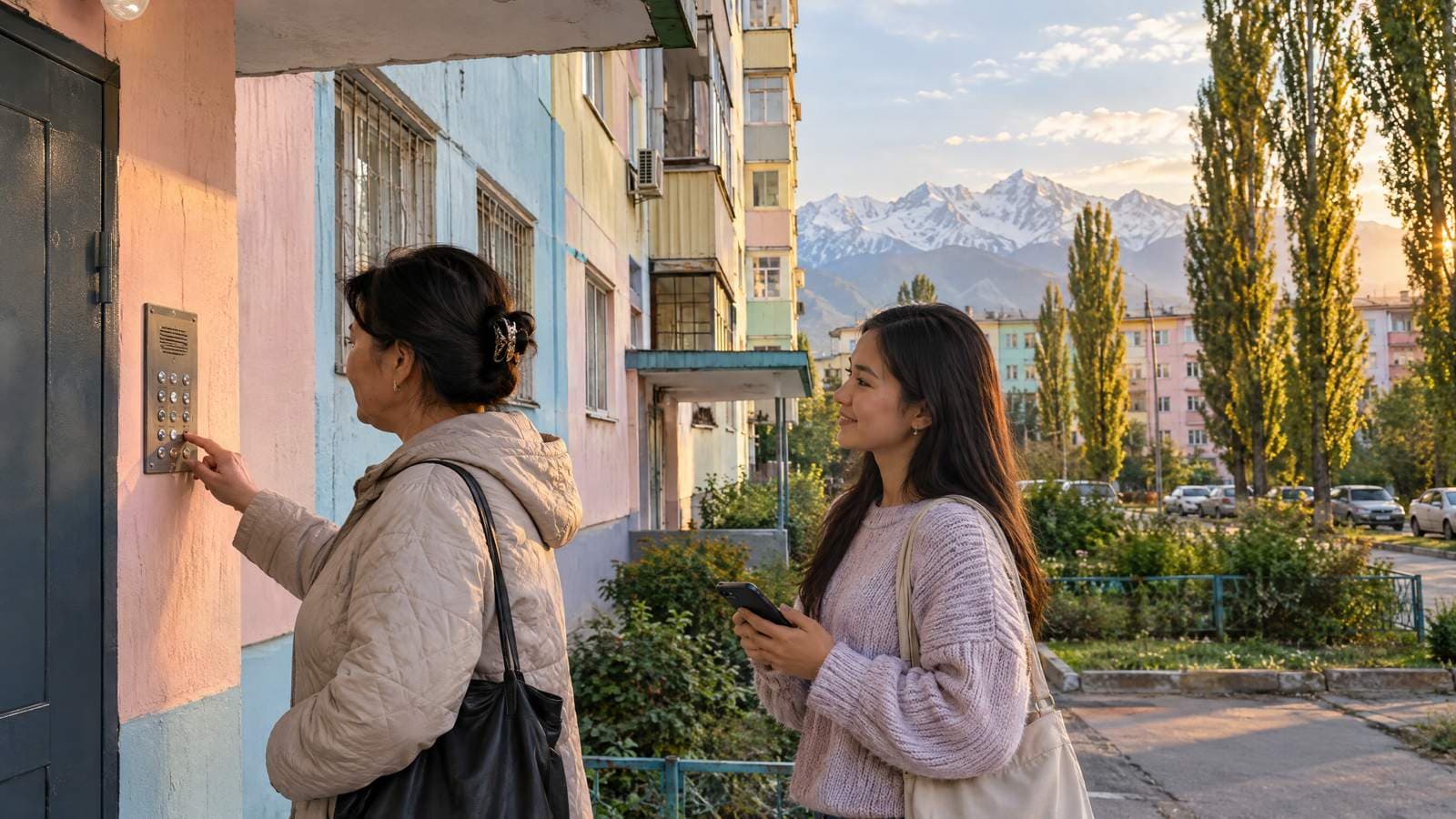
The short version: in Kyrgyzstan the law is silent about the intercom, so the charge rests on the general rule. Owners share in the costs of the common property in proportion to their share, and the general meeting sets the amount for a year. Below: how that reads for an intercom, what is disputed, what to do about a non-payer and how to collect per flat account.
This covers the case where a ТСЖ (owners' association) or a managing organization collects the fee. A separate service company that maintains intercoms under its own contracts with residents is outside this article.
What the law says about the intercom
The Housing Code does not use the word "intercom". Article 1 defines common property as "помещения, внутридомовые сети и инженерное оборудование, в том числе оборудование связи, обслуживающие более одного собственника" (premises, in-house networks and engineering equipment, including communications equipment, serving more than one owner), followed by a list: entrances, stairs, the roof and others. The same Code defines communications equipment as "технические средства для направления, коммутации или передачи сообщений электросвязи, включая голосовые, звуковые, визуальные сообщения, передачу данных и изображения" (technical means for sending, switching or transmitting telecommunication messages, including voice, sound and visual messages, data and images; art. 1). An entrance intercom serves several owners, but whether it is "communications equipment" the text does not say. That is a reading, not a rule, and it should be presented as one in the building's papers.
The list of in-house networks in article 76 covers gas, water, heat, electricity, lifts, fixed telephone lines, internet and cable television. The intercom is not in it.
Who pays
The rule is general: an owner "обязан участвовать в расходах на управление общим имуществом ... соразмерно своей доле" (must take part in the costs of managing the common property in proportion to their share), whatever the management form (art. 37, para. 1). The duty starts when ownership arises (para. 3) and temporary absence does not excuse payment (para. 5). A tenant is not named in these provisions; how a tenant settles with the owner depends on their agreement.
Who sets the amount
"Размер платы на управление общим имуществом многоквартирного дома определяется решением общего собрания собственников жилых помещений и определяется на один год" (the amount is set by decision of the general meeting of owners, for one year; art. 37, para. 2). In a ТСЖ the order is: an annual income and expenditure estimate, then, on its basis, the payments for each owner in line with the owner's share (Law No. 122, art. 6, para. 1, sub-paras 2 and 3).
The conclusion for an intercom: put it into the estimate and the meeting minutes, for a year. The law gives neither a rate nor a ceiling.
The disputed point is a fixed sum "per flat". The Code requires participation "in proportion to the share" (art. 37, para. 1) and Law No. 122 "in proportion to their share in the common property" (art. 22, para. 1). There is no express ban on a fixed sum, but calculating from the share is safer. An equal amount per flat, even if approved by the meeting, can be challenged, and payments that do not conform to the Code are a ground to withhold (Law No. 122, art. 22, para. 3, sub-para. 4).
If an owner does not pay
- Those managing the building may go to the executive bodies of local self-government or to court to recover the debt (art. 37, para. 7).
- A ТСЖ may set a penalty for late payment "сумма которой не может превышать 20 процентов от общей суммы долга" (the amount of which may not exceed 20 percent of the total debt; Law No. 122, art. 6, para. 3). The Code has no such rule for a managing organization: a penalty, if any, is set by its contract.
- A debt for management costs passes to the new owner with the premises (art. 37, para. 4).
And the other side. Members of a ТСЖ and owners may withhold mandatory contributions in the cases named in Law No. 122, art. 22, para. 3, which include: where the ТСЖ does not settle cashlessly from 1 January 2026; where the board does not report on time; where the mandatory payments do not conform to the Housing Code. Charging for the intercom with no meeting decision and cash in the stairwell hands an owner a ready reason not to pay.
How to collect: account, line, flat account
The law requires mandatory payments to be received into a bank account, with records kept cashless (Law No. 122, art. 7, para. 11; Housing Code, art. 33 for a managing organization). It does not require a separate account for each building. The form and deadline of a bill are not fixed: payments are made monthly, in the manner set by the charter (art. 22, para. 2).
Practice that asks nothing beyond that:
- The intercom as its own line on every flat's bill, with the amount and a reference to the minutes.
- The payment tied to the flat's account, with the intercom debt visible apart.
- The amount fixed by the general meeting's decision for the year (art. 37, para. 2) or by the annual estimate (Law No. 122, art. 6, para. 1, sub-paras 2-3), and the payment procedure and date in the charter (art. 22, para. 2), not in correspondence.
How Unitify does it
Unitify billing builds charges by category: per flat, per square meter, per resident or as a fixed sum, and matches payments per flat. The intercom goes on each flat's bill as its own line, and residents see it in the app. This is not bookkeeping: receiving payments into a bank account and keeping the income and expense records the law requires of a ТСЖ or managing organization stay with you and your accountant; billing shows charges and payments per flat. If the entrances have an intercom with an integration interface (API, SIP), we connect it on request as a project: separate work on your equipment.
See Unitify for Kyrgyzstan, billing and pricing, or book a demo.
Sources: Housing Code of Kyrgyzstan of 09.07.2013 No. 117 (edition of 06.08.2025), arts. 1, 33, 37, 76; Law of Kyrgyzstan of 09.07.2013 No. 122 on owners' associations of residential and non-residential premises in multi-apartment buildings (edition of 28.05.2025), arts. 6, 7, 22; cbd.minjust.gov.kg. Checked 9 October 2026; recheck the current edition before a meeting vote.
Frequently asked questions
Does the Housing Code of Kyrgyzstan mention the intercom?
No. The word "intercom" (домофон) does not appear in the Code. Article 1 defines common property through "in-house networks and engineering equipment, including communications equipment, serving more than one owner". Whether an entrance intercom is communications equipment is not stated in the text; that is a matter of reading. The list of in-house networks in art. 76 does not name an intercom.
Who pays for the intercom in a multi-apartment building?
An owner of residential or non-residential premises takes part in the costs of managing the common property in proportion to their share, whatever the management form (Housing Code, art. 37, para. 1). The duty starts when ownership arises and temporary absence is no excuse (art. 37, paras 3, 5).
Who sets the amount?
The general meeting of owners, for one year (art. 37, para. 2). In a ТСЖ the payments for each owner are set from the annual income and expenditure estimate, in line with the owner's share (Law No. 122, art. 6).
Can every flat be charged the same intercom amount?
The Code requires participation "in proportion to the share" (art. 37, para. 1) and Law No. 122 "in proportion to their share in the common property" (art. 22, para. 1). There is no express ban on a fixed sum, but it is disputed: calculating from the share is safer. An equal amount per flat, even if approved by the meeting, can be challenged, and payments that do not conform to the Code are a ground to withhold (Law No. 122, art. 22, para. 3, sub-para. 4).
What if an owner does not pay?
Those managing the building may go to the executive bodies of local self-government or to court (Housing Code, art. 37, para. 7). A ТСЖ may set a penalty of no more than 20% of the debt (Law No. 122, art. 6, para. 3). The debt passes to the new owner with the premises (art. 37, para. 4).
Can owners refuse to pay the ТСЖ?
In the cases named in Law No. 122, art. 22, para. 3, which include: the ТСЖ does not settle cashlessly from 1 January 2026, the board does not report on time, or the mandatory payments do not conform to the Housing Code. An intercom charge with no meeting decision and no cashless account gives grounds for that dispute.