
Convening a Slovenian Owners' Assembly: Notice and Quorum
A Slovenian owners' assembly (zbor lastnikov) is convened by the manager, by owners holding at least one fifth of the co-ownership shares, or by the supervisory board, with a written invitation at least 14 days before the assembly. The Housing Act (SZ-1) has no fixed quorum percentage: the assembly decides validly if the majority the law requires for that decision is present. If that majority is missing, those present can decide to hold a repeat assembly, which decides on ordinary management by a majority of those present.
Who can convene
Under art. 34 of SZ-1 an owners' assembly can be convened by:
- the manager,
- owners who together hold at least one fifth of the co-ownership shares,
- the supervisory board.
The manager must convene and hold an assembly at least once a year.
The invitation: written, 14 days ahead, mailbox and notice board
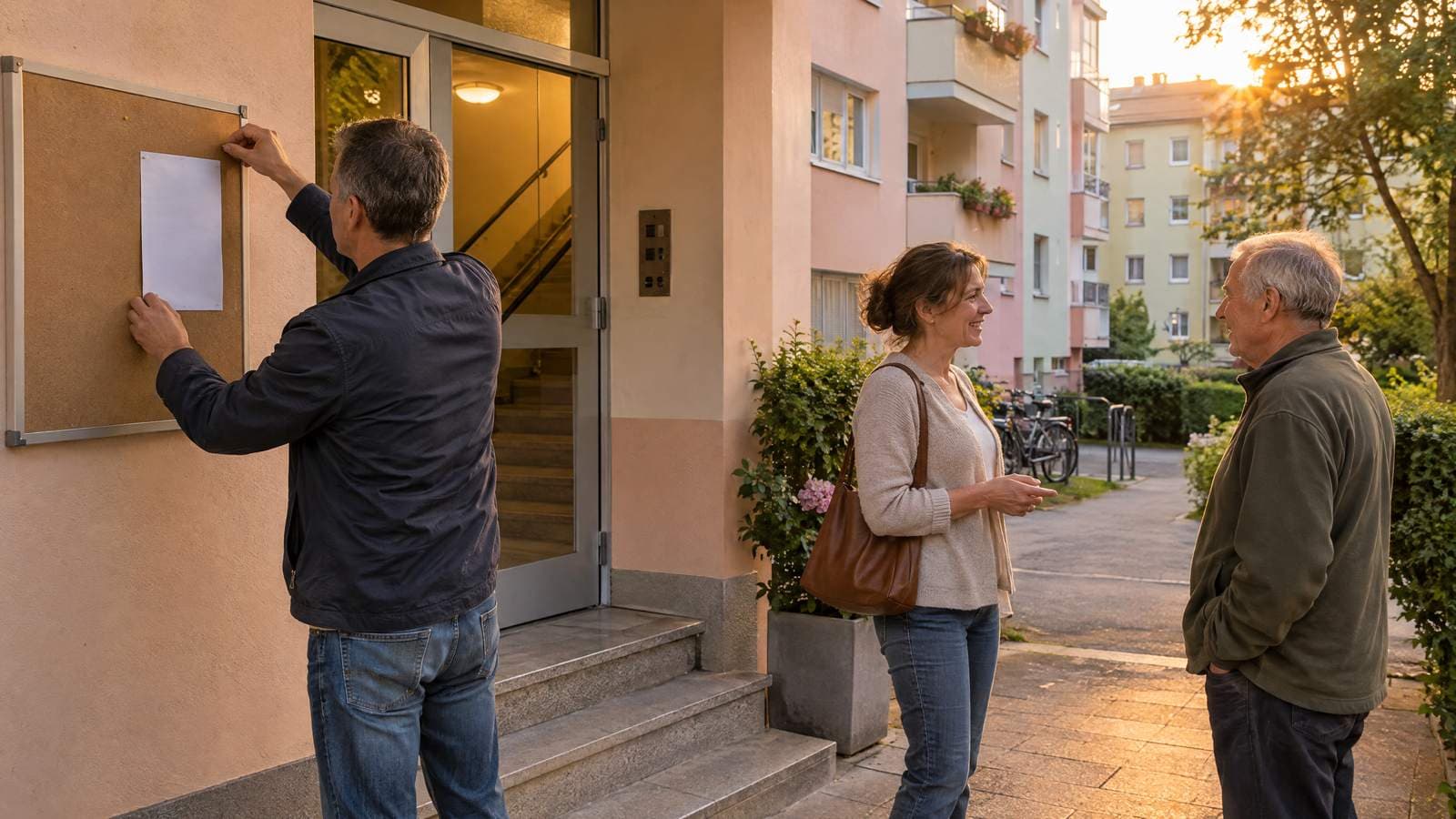
Under art. 36 of SZ-1, the assembly is convened with a written invitation at least 14 days before it. The manager leaves the invitation in each owner's house mailbox and posts it on the notice board or another place open to all owners. At the request of an owner who does not live in the building, the manager sends it by email.
The invitation must contain, among other things, the day and hour of the assembly, the planned agenda and the proposed resolutions.
Invitation template (vabilo)
INVITATION TO THE OWNERS' ASSEMBLY (VABILO NA ZBOR ETAŽNIH LASTNIKOV)
Multi-apartment building [address]
Manager: [name, contact]

Dear owners,

you are invited to the owners' assembly to be held
on [date] at [time] in [place].

PLANNED AGENDA
1. Election of a minute-taker and two verifiers of the minutes.
2. Manager's report on the management of the building for [year].
3. [Subject of the decision]
   Proposed resolution: "[text of the proposed resolution]"
   Required majority: [more than half of the co-ownership shares / more than three quarters
   of the co-ownership shares / all owners' consent, e.g. borrowing
   against the reserve fund]
4. [Subject of the decision and proposed resolution]
5. Any other business.

REPEAT ASSEMBLY (fill in only if this invitation is for a repeat assembly)
The assembly convened for [date] was not quorate. This repeat assembly will
decide the proposed resolutions that concern ordinary management by a
majority of the owners present, counted by co-ownership shares.

POWER OF ATTORNEY
An owner may attend through a written proxy.
Power of attorney: the undersigned ____________, owner of unit no. ______,
authorises ____________ to represent me and vote on my behalf at the
assembly convened above.
Date ____________            Signature ____________

This invitation was delivered to each owner's house mailbox and posted on
the notice board on [date], at least 14 days before the assembly.

[Place], [date]                         Manager ____________
What in this template is law and what is practice. The law requires the written form, the 14-day period, delivery to the mailbox and posting, the day, the hour, the agenda and the proposed resolutions. A numbered agenda, the required majority next to each item and the proxy line are practice, which makes it easier to check the resolutions item by item. The repeat-assembly block rests on art. 37 of SZ-1, which expressly requires a warning about the lower majority in the invitation to a repeat assembly.
Quorum: no fixed percentage
SZ-1 has no quorum in percentages. Under art. 37 an owners' assembly decides validly if the majority required by law for the decision is present. In practice that means:
- more than half of the co-ownership shares for ordinary management (operation and maintenance, appointing and dismissing the manager, adopting the maintenance plan, rejecting the manager's report),
- more than three quarters of the co-ownership shares for decisions beyond ordinary management (among others the agreement on mutual relations and building works on common parts that need a building permit),
- the consent of all owners for a handful of decisions, among them taking on and repaying a loan charged to the reserve fund.
The majority is counted in co-ownership shares, not heads. The convener checks the quorum before the voting starts by collecting the signatures of those present on a list of owners that shows their co-ownership shares.
The repeat assembly
If a proposed decision fails because the required majority was not present, the assembly may decide, by a majority of the owners present counted by co-ownership shares, that the manager is to convene a repeat assembly. At the repeat assembly, proposals that were named in the invitation and concern ordinary management can be validly decided by a majority of the owners present, counted by co-ownership shares. The invitation to a repeat assembly must contain a warning about this lower majority.
Be careful with the deadline, because two texts are in force. SZ-1 (art. 37) says the manager convenes the repeat assembly within at most 14 days, while the Rules on the management of multi-apartment buildings (art. 10) say the manager must send the invitations at least 14 days before the repeat assembly. Both are in force, so do not summarise them as one number. In practice, align the date of the repeat assembly with the invitation period before posting.
Those present at an assembly that is not quorate can also decide by majority to move to decision-making by signing a document or by electronic voting.
Proxies
An owner or co-owner may authorise another person in writing to decide on his behalf. The power of attorney may be given permanently or for one decision, and a permanent one must be notarised. Where a unit is co-owned, each co-owner decides only to the extent of his own co-ownership share.
The two other ways to decide: signing a document and electronic voting
Under art. 34 of SZ-1 owners may also decide by signing a document or by electronic voting, with the same force as at an assembly. A document that is signed must state, among other things, the owner's name, the date of signature and the majority required for adoption, and the proposal is adopted if the required number of owners sign it within a period of no more than three months from posting on the notice board.
Electronic voting has been in SZ-1 since June 2021 (art. 35.a). The implementing rules require the owner to use a qualified electronic signature, and the proposed resolutions must still be posted on the building's notice board when the vote opens. An individual owner decides on an individual resolution by only one of the prescribed ways of voting.
The minutes
The manager must draw up the minutes within 30 days after each assembly. The minutes are confirmed when two owners chosen by those present sign them. The two verifiers must sign or refuse within seven days of receipt, otherwise the minutes are deemed confirmed, and the manager must correct any defects in a new set of minutes within 7 days. The minutes contain the place and time of the assembly, the list of owners present with signatures, the proposed resolutions and the voting results, and the manager publishes them the same way the assembly was convened.
Importantly, the manager starts carrying out the resolutions only once the minutes are confirmed.
How Unitify works here
Unitify does not replace the written invitation in the mailbox and on the notice board, and it does not replace the minutes.
- Invitation. The resident app can deliver a copy of the invitation and agenda to residents, as an addition to the statutory invitation.
- A survey before the assembly. The manager can set up a survey (a general opinion question) to see where residents stand before the assembly. We make no claim of legal effect: the law decides that.
- What Unitify does not do. It has no video calling of its own and does not provide a qualified electronic signature, so an electronic vote under art. 35.a of SZ-1, for which the implementing rules require a qualified electronic signature, cannot be completed in Unitify alone. A vote in an app also does not by itself make an assembly legally valid.
See the Slovenia page and pricing, or read how owner voting works. To see how this would run for your buildings, book a demo.
Frequently asked questions
Who can convene an owners' assembly?
The manager, owners who together hold at least one fifth of the co-ownership shares, or the supervisory board. The manager must convene and hold an assembly at least once a year.
How many days ahead must the invitation go out?
An assembly is convened with a written invitation at least 14 days before it. The manager leaves it in each owner's house mailbox and posts it on the notice board or another place open to all owners. At the request of an owner who does not live in the building, the manager also sends it by e-mail.
What is the quorum for an owners' assembly?
There is no fixed percentage. The assembly decides validly if the majority the law requires for that decision is present: more than half of the co-ownership shares for ordinary management, more than three quarters for decisions that go beyond it.
What if too few owners attend?
Those present may decide, by a majority of the co-ownership shares present, that the manager is to call a repeat assembly. At it, proposals that were named in the invitation and concern ordinary management can be validly decided by a majority of the owners present, counted by co-ownership shares.
Can a proxy attend instead of the owner?
Yes, under a written power of attorney. It may be given for one decision or as a standing one, and a standing power of attorney must be notarised.