
Italian Condominium Regulation: Contents and Approval
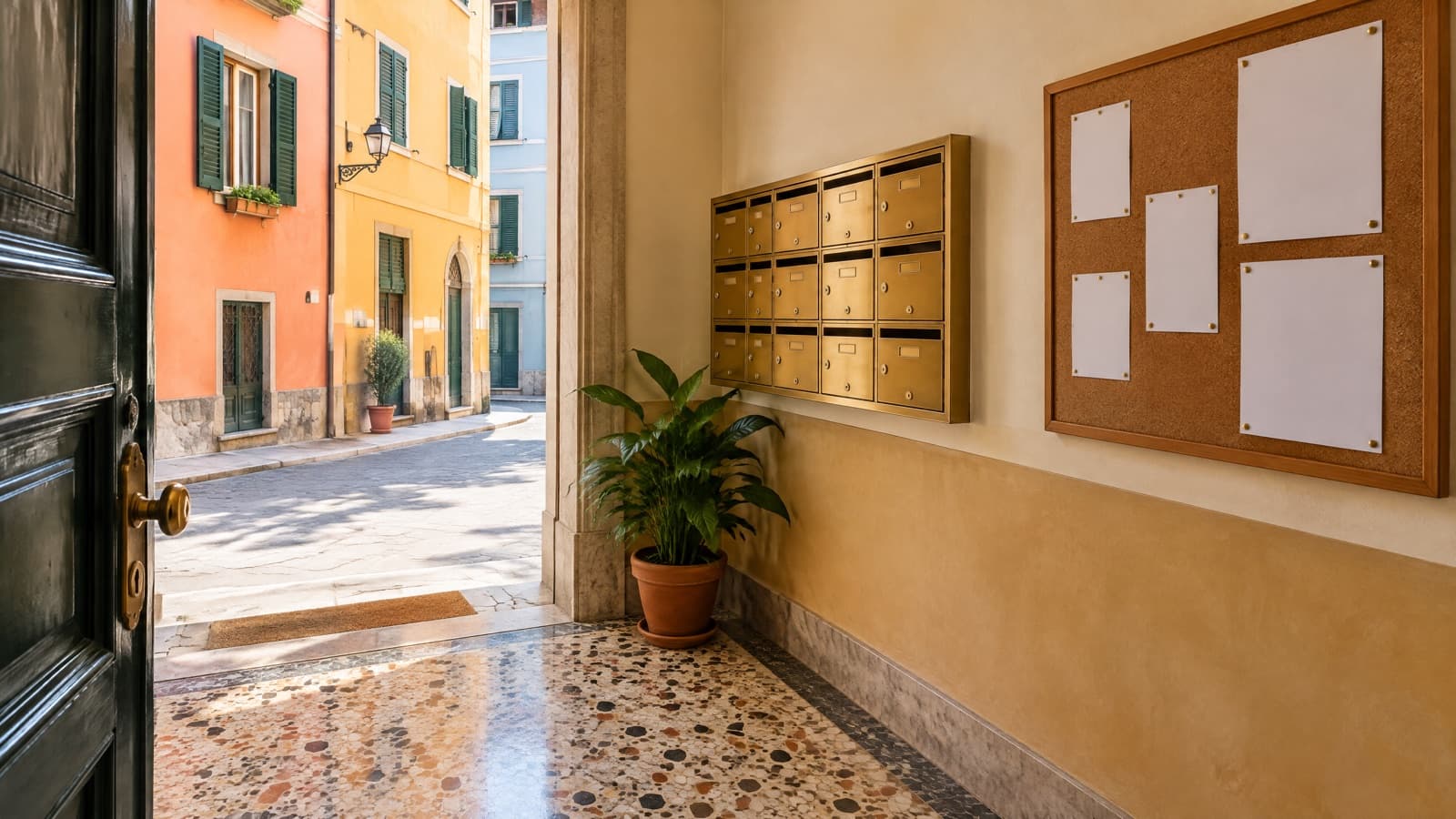
A condominium regulation is the text that says how a building is lived in and run: what use is made of the common parts, how expenses are split, who decides what. It is a much-searched and little-read document: few co-owners know what theirs contains, and fewer still know who can change it. Here is what the law says, in its own words, and an outline to adapt. The outline is in Italian because it is meant for Italian buildings.
When it is compulsory
Art. 1138 of the Civil Code begins: "Where the number of co-owners in a building is more than ten, a regulation must be drawn up". The article speaks of the number of co-owners, not of units. How an owner of several units is counted is not stated in the text: we do not present a rule as if it were law. For buildings with ten co-owners or fewer, this article says nothing more.
What it must contain
The first paragraph of art. 1138 lists three groups of rules. The regulation contains:
- "the rules on the use of common things and the sharing of expenses, according to the rights and obligations of each co-owner";
- "the rules for protecting the building's decorum";
- the rules "on administration".
On top of this comes the millesimal table. Art. 68 of the implementing provisions provides that, where the title does not specify otherwise, each unit's proportional value is expressed in thousandths "in a dedicated table annexed to the condominium regulation". How millesimi are calculated and what the law says about the tables is in Tabelle Millesimali: what Italian law says. If you already have the table and need to split an expense, there is the millesimi splitter (an Italian-language page).
Art. 1138 does not name quiet hours, and the Civil Code does not name them anywhere in the condominium provisions. If you want them, they must be written into the regulation: see quiet hours in an Italian condominium.
Who approves it, and how
The procedure sits in two paragraphs.
The initiative. "Each co-owner may take the initiative for forming the condominium regulation or revising the existing one" (second paragraph). You do not have to be the administrator or sit on the council.
The approval. The third paragraph says the regulation "must be approved by the assembly with the majority set by the second paragraph of art. 1136 and attached to the register referred to in no. 7 of art. 1130". The second paragraph of art. 1136 treats as valid resolutions approved by votes representing "a majority of those present" and "at least half of the building's value". The register in no. 7 of art. 1130 is the register of assembly minutes, to which "the condominium regulation, where adopted, is attached".
Two practical consequences. The proposal must be on the agenda of the notice of convocation, written specifically: periods and channels are in convocation of the assembly: notice and deadlines, the document in the notice template. The quorums for constituting the assembly apply, in second convocation too, but the regulation always needs the art. 1136 second-paragraph majority (a majority of those present and at least half of the building's value), even in second convocation. We explain the quorums in second convocation and quorum.
The same third paragraph adds that the regulation "may be challenged under art. 1107". We do not explain the mechanism here: the reference is to art. 1107, which we have not examined.
What it cannot provide
The regulation has written limits. The fourth paragraph of art. 1138 says its rules "may in no way impair the rights of each co-owner, as they result from deeds of purchase and agreements" and that "in no case may they derogate" from arts. 1118 (second paragraph), 1119, 1120, 1129, 1131, 1132, 1136 and 1137. The fifth paragraph adds that they cannot "forbid keeping or possessing pets".
The implementing provisions have a list of their own: art. 72 says that condominium regulations "may not derogate from the provisions of the preceding arts. 63, 66, 67 and 69". Those are, in order, the rules on collecting contributions, on convocation, on representation in the assembly and on revising the millesimal tables. Art. 68 is not on the list. We add nothing more: knowing what the list contains is enough not to read it wider than it is.
In practice: if a clause comes from the deeds of purchase or from an agreement among all the co-owners (the regulation usually called "contractual"), it is not changed by the art. 1136 majority, and a new clause approved by majority cannot take those rights away. For a concrete case, legal advice is advisable.
Penalties and observance
Art. 70 of the implementing provisions says that "for breaches of the condominium regulation a sum of up to 200 euros may be set as a penalty" and, "in case of repeat offence", up to 800 euros. The sum "goes to the fund the administrator holds for ordinary expenses", and imposing the penalty is decided by the assembly with the majorities of art. 1136, second paragraph.
The Civil Code entrusts the administrator with seeing that the regulation is respected: art. 1130, no. 1, requires them to "see to the observance of the condominium regulation", and no. 2 to "regulate the use of common things and the enjoyment of services in the common interest, so that each co-owner's best enjoyment is assured".
An outline to adapt
This is not a ready regulation: it is the index of one. The text of each article depends on the building, the millesimal table and what the assembly decides, and the regulation applies only after approval with the majority above. Square brackets are placeholders.
REGOLAMENTO DEL CONDOMINIO [via e numero civico, città]

Art. 1 - Oggetto e parti comuni
        Elenco delle parti comuni dell'edificio e di quelle di uso
        esclusivo [scale, cortile, tetto, impianti, altro].
Art. 2 - Uso delle parti comuni
        Regole d'uso di androne, scale, cortile, ascensore [e altro]:
        [regole decise dall'assemblea].
Art. 3 - Decoro dell'edificio
        Facciate, balconi, tende, targhe: [regole decise dall'assemblea].
Art. 4 - Quiete e rumori
        Fasce orarie di quiete: [dalle __ alle __]. Lavori nelle unità:
        [fasce orarie e comunicazione].
Art. 5 - Spese e ripartizione
        Criteri di ripartizione (artt. 1123 e seguenti c.c.), tabelle
        millesimali allegate [Tabella A, Tabella B...].
Art. 6 - Amministrazione
        Nomina, durata, compiti; assemblea e convocazione; rendiconto
        annuale; fondo per le spese ordinarie.
Art. 7 - Animali domestici
        [Regole di convivenza che non vietano di possedere o detenere
        animali domestici, art. 1138, quinto comma, c.c.]
Art. 8 - Infrazioni e sanzioni
        [Se previste: importo entro i limiti dell'art. 70 disp. att.;
        l'irrogazione è deliberata dall'assemblea.]
Art. 9 - Modifiche del regolamento
        Iniziativa di ciascun condòmino, approvazione dell'assemblea.
Allegati: Tabella millesimale (art. 68 disp. att.) [e altre tabelle].
What Unitify does
An approved regulation has to be communicated. On Unitify the notice reaches every owner in the app, by email and on the building website, with read receipts (the app does not yet have an Italian interface; the texts you write stay in Italian), and the app lets you collect owners' positions before the meeting. The in-app vote helps see where there is agreement: it replaces neither the assembly nor the convocation channels of art. 66.
If you are moving from another program, the regulation and the millesimal tables have to travel with the building's data: see switching condominium software.
If your firm manages several condominiums and every regulation lives in a different folder, you can start free from the Unitify page for Italy.
Sources: Civil Code, arts. 1130, 1136 and 1138; implementing provisions of the Civil Code, arts. 68, 70 and 72, Normattiva, accessed 16.10.2026. The quotations are our translation of the Italian text; the source texts are in the internal pack research/66.
Frequently asked questions
When is a condominium regulation compulsory in Italy?
When the number of co-owners in a building is more than ten (art. 1138, first paragraph, of the Civil Code). The article speaks of the number of co-owners, not of units; how an owner of several units is counted is not stated in the text. For smaller buildings this article says nothing more.
What must the condominium regulation contain?
The rules on the use of common things and the sharing of expenses, according to each co-owner's rights and obligations, the rules for protecting the building's decorum and those on administration (art. 1138, first paragraph). The millesimal tables are annexed to the regulation (art. 68 of the implementing provisions).
Who approves the regulation, and by what majority?
The assembly, with the majority set by the second paragraph of art. 1136: a majority of those present and at least half of the building's value. Any co-owner may take the initiative to form it or revise the existing one. The regulation is attached to the register of minutes (art. 1138, second and third paragraphs).
What can a condominium regulation not provide?
It cannot impair each co-owner's rights as they result from deeds of purchase and agreements, nor derogate from arts. 1118 (second paragraph), 1119, 1120, 1129, 1131, 1132, 1136 and 1137 of the Civil Code; it cannot forbid keeping or possessing pets (art. 1138, fourth and fifth paragraphs). It cannot derogate from arts. 63, 66, 67 and 69 of the implementing provisions (art. 72).
Can the regulation provide penalties for breaking it?
Art. 70 of the implementing provisions provides that for breaches of the regulation a sum of up to 200 euros may be set and, for repeat offences, up to 800 euros; imposing it is decided by the assembly with the majorities of art. 1136, second paragraph.
Are quiet hours in the condominium regulation?
The Civil Code neither sets them nor lists them among the regulation's contents. If your building's regulation has them, they are there; otherwise they can be proposed to the assembly as a change to the regulation.