
Smart Building for a Residential Complex in Uzbekistan: A Practical Guide
Uzbekistan’s housing sector is in the middle of a genuine digital shift, and it is being driven as much by law and infrastructure programs as by developers experimenting with gadgets. For a developer or management company planning a "smart" residential complex, the practical question is less "which devices to buy" and more "which system those devices need to plug into."
Who actually manages a building
Per the presidential press service (14 January 2026), Uzbekistan's 44,000+ multi-apartment buildings, home to 7.1M residents, are served by 900+ management service companies and 200+ homeowners' associations, with self-management in place in 856 buildings. A management company, not a ТЧСЖ (Uy-joy mulkdorlari shirkati, a homeowners' association of the unit owners), runs most buildings.
The current legal basis is Law No. ЗРУ-581 of November 7, 2019, "On the Management of Multi-Apartment Buildings" (art. 8, as amended by Law No. ЗРУ-1109 of December 30, 2025), which gives owners three forms of management: direct management by the owners themselves, a management organization or manager under contract, or a ТЧСЖ. A branded management company at handover is a different operating model from handing the keys to a homeowners' board, which is why the choice matters to a developer deciding how the building will run after handover.
Where the money moves: Mening uyim and the payment rails
Mening uyim ("My Home") is the mandatory state information billing system, operated under Uzbekistan's Ministry of Construction and Housing and Communal Services. Under Presidential Resolution ПҚ-48 of February 5, 2026, from July 1, 2026, accounting of mandatory payments runs only through Mening uyim nationwide, and in Tashkent so do general meetings, contracts, manager reports and resident appeals, extending to the whole country from 2027. Every building already in service gets, on the manager's application, a taxpayer ID and its own bank account, in the owners' name, by the same July 1, 2026 deadline. No published act grants third-party software an API or integrator status for Mening uyim, so any smart building or billing platform in Uzbekistan runs alongside it, not on top of its data.
On the resident side, housing and utility payments already flow through channels people use every day: Payme and Click, both built on the national Uzcard and Humo card rails. This is not Mening uyim: Unitify processes payments through Payme directly, while Click remains a rail residents already reach for on their own, not connected to the platform. Mandatory payments themselves run only through a bank or electronic channel — bank card, electronic payment system, or bank cash desk; cash paid directly to the management company is not a permitted channel.
Smart meters are becoming infrastructure, not a feature
The clearest sign that "digital building" is moving from developer marketing to government program is the water meter rollout in Tashkent. In mid-2025 the city began mass installation of smart water meters: according to press reports, the city targeted 50,000 meters by the end of 2025 and a plan to reach 670,000 meters by 2030 through Toshkent shahar suv ta'minoti — figures reported by spot.uz and gazeta.uz, not found in any published decree. No decree setting a nationwide smart-water-meter mandate for new construction from 2027 was found either; treat that date as press reporting, not settled law, until one surfaces.
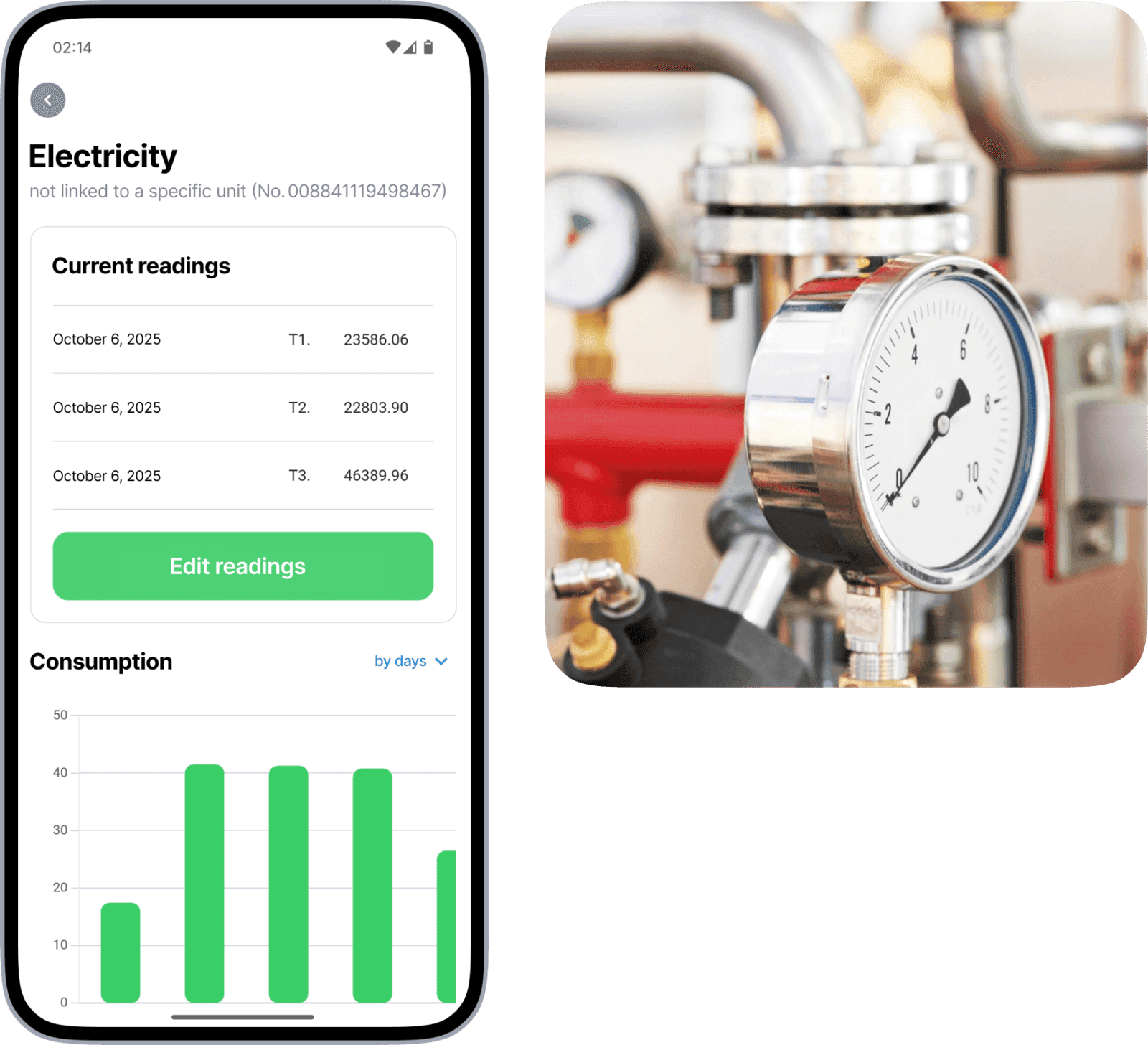
For a building’s back office, this changes what "billing" means. Instead of a caretaker walking meter rounds once a month, readings arrive automatically and need to land directly in the billing calculation, not in a second spreadsheet someone reconciles by hand.
Why this matters at handover
A developer only gets one chance to wire a building before residents move in. Access control panels, intercom cabling, and meter dispatching hardware are far cheaper to install during construction than to retrofit into finished units and common areas afterward. That makes the handover moment the real decision point, not a software choice to revisit later: whether the building ends up run by a management company or a ТЧСЖ board, whoever manages it inherits whatever access, intercom, and metering systems were installed at construction, along with however many separate vendor apps and logins that implies.
What a smart building platform needs to cover
Put together, a residential complex in Uzbekistan that wants to be genuinely "smart" rather than just "wired" needs one platform underneath access control, video intercoms, and smart meters, not four separate vendor apps: access control at entrances, parking, and lobbies; video intercoms with app-based unlocking; automatic ingestion of smart meter readings into dispatching; and one resident app that covers doors, requests to the management company or ТЧСЖ, and paying the housing account through the rails residents already use.
That is the model Unitify built for developers and management companies in Uzbekistan: one system that sits on top of either a management company or a ТЧСЖ board, runs alongside Mening uyim rather than claiming to connect to it, and gives residents one app instead of one login per vendor. See the full Smart Building overview for Uzbekistan for how it fits together.
Frequently asked questions
Who actually manages multi-apartment buildings in Uzbekistan, ТЧСЖ or a management company?
Per the presidential press service (14 January 2026), Uzbekistan's 44,000+ multi-apartment buildings are served by 900+ management service companies and 200+ homeowners' associations (ТЧСЖ). A management company, not a ТЧСЖ, runs most buildings. Law ЗРУ-581 (as amended by Law ЗРУ-1109 of 30 December 2025) gives owners three forms: direct management, a management organization or manager under contract, or a ТЧСЖ.
What is Mening uyim, and does a smart building platform connect to it?
Mening uyim is the mandatory state information billing system: from 1 July 2026, accounting of mandatory payments runs only through it, and in Tashkent so do general meetings, manager reporting and resident appeals (nationwide from 2027). No published act grants third-party software an API or integrator status for Mening uyim, so a smart building platform runs alongside it rather than connecting to it.
Which payment methods do residents already use for housing bills?
Unitify processes residents' card payments through Payme; Click is a second channel residents already use, not connected to Unitify. Both run on the national Uzcard and Humo card rails. From 1 July 2026, mandatory payments themselves are accepted only by bank card, electronic payment system, or bank cash desk, and accounted for only in Mening uyim.
Are smart water meters actually being installed in Tashkent, or is this still a pilot?
It is an active rollout, not a pilot, per press reporting: the city targeted 50,000 smart water meters by the end of 2025, with a plan to reach 670,000 meters by 2030 (spot.uz, gazeta.uz). Neither figure, nor a mandatory-installation rule for new construction from 2027, was found in any published decree.
What should a developer look for in a smart building platform for a new complex?
One system that covers access control, video intercoms, smart meter dispatching, and a resident app together, rather than separate vendor apps for each, built for whichever legal form ends up managing the building - a ТЧСЖ board or a professional management company - and for what Mening uyim does not cover.