
Association Dues Collection Software for Philippine Condominium Corporations: A PMO Checklist
The board approves the budget. The treasurer chases the payments. The property management office (PMO) does the daily work: prepares the Statements of Account, answers unit owners, follows up on arrears, and reports back to the board.
In most condominium corporations that daily work still runs on spreadsheets, chat messages and one person who knows how the file works. This article is a checklist for that person, and for the board that depends on them.
Start with the words your unit owners use
Get the language right first. Software built for another market will not.
- The body is a condominium corporation, run by a board of directors. A subdivision or village is a homeowners association. They are different structures, and a tool should name both.
- The regular monthly charge is association dues, or condo dues in a tower.
- The reserve is the sinking fund. A one-off charge is a special assessment.
- The person who pays is the unit owner. The person who sends the bill is the PMO.
- The bill itself is the Statement of Account (SOA).
- The rules live in the master deed and the house rules.
If a vendor's screens speak the vocabulary of leasing or of another country's buildings, the product was built for someone else.
For the legal frame, two names are enough here. RA 4726 (The Condominium Act) is the framework for condominium corporations. RA 9904 (the Magna Carta for Homeowners and Homeowners' Associations) is the framework for subdivisions and villages. What either one requires of your dues, your collection powers or your voting is a question for your counsel, not for software.
What the PMO actually does every month
Look at one billing cycle from the PMO desk.
- Confirm the unit list and each unit owner's account.
- Apply the charges: association dues, parking dues, water, the sinking fund contribution, and any special assessment approved by the board.
- Prepare and send the SOA to every unit owner.
- Record payments as they arrive.
- Show the treasurer who has paid and who is in arrears.
- Answer the unit owner who says the amount is wrong.
Software earns its place in steps 2 to 6. If it only produces a nicer document at step 3, you have bought a template.
The checklist
Use these as questions for any vendor, ours included.
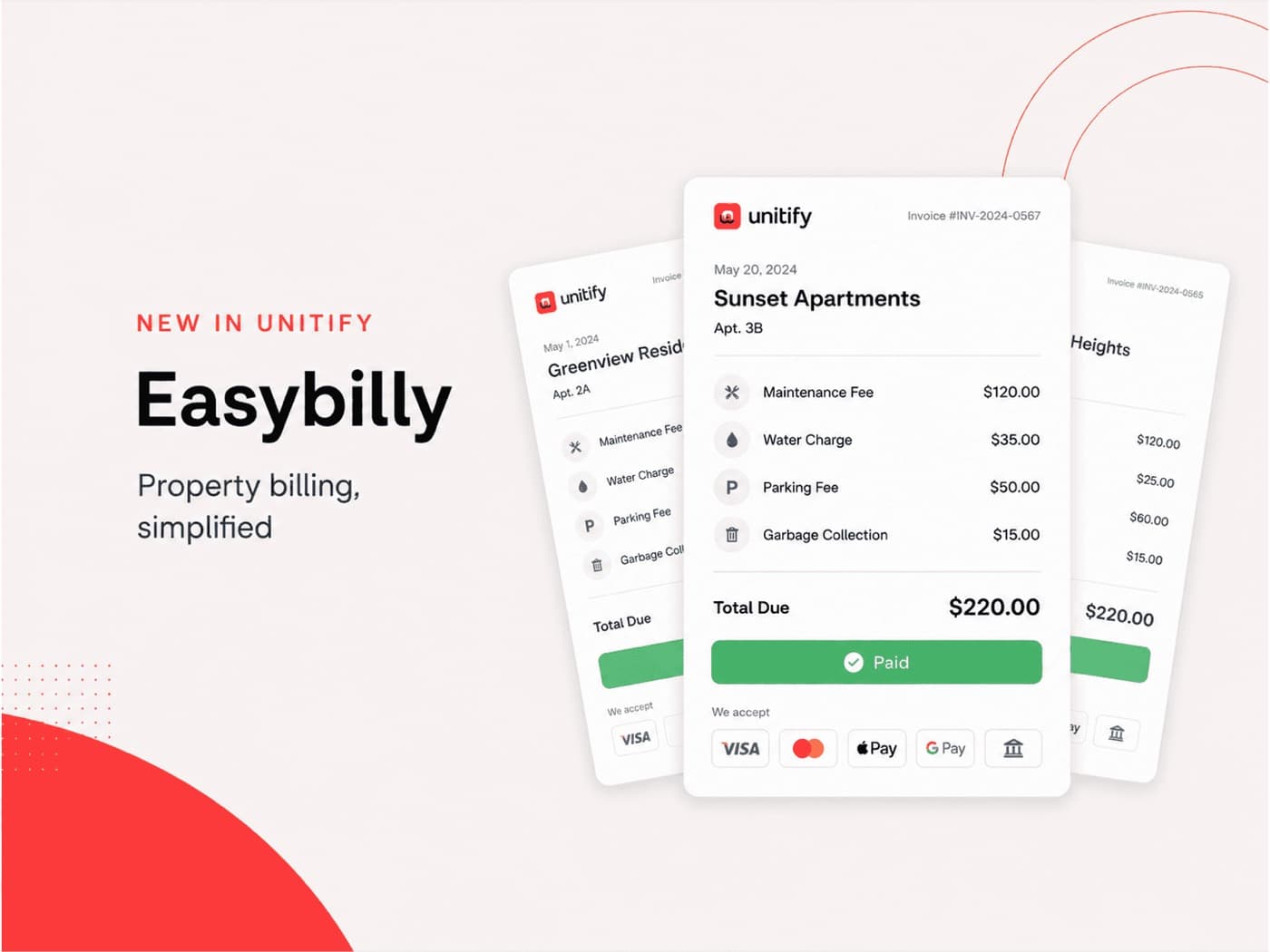
1. Does it model your charges, or only one? Dues may be computed per square meter, per unit, or as a flat amount, and every building has its own mix. Ask to see two different rules running in one building. In Unitify's billing module, Easybilly, you set the rule per building: per square meter, per unit, per resident or a flat amount. The sinking fund contribution and a one-off special assessment can be their own charge lines, so the SOA shows where each number came from.
2. Can you bring your history with you? Nobody re-types a ledger. Ask whether units, owners and opening balances import from Excel or from your current system. In Easybilly they do, so the first month starts from what unit owners actually owe, not from zero.
3. Does the unit owner see the bill without calling the PMO? A large share of what a PMO answers is "how much do I owe?" Ask where the unit owner sees the amount, the breakdown and the payment status. In Unitify the bill goes to the resident app, with a PDF for those who prefer one.
4. Can the treasurer see arrears in one screen? The board needs to know who is delinquent without asking the PMO to build a report. Ask for the arrears view by unit owner, and how quickly it updates after a payment is recorded. In Easybilly the building's balances sit on one screen, unit by unit.
5. How does the money move, and who touches it? This is the question that decides most purchases. Be precise about what the software does and does not do.
Unitify does not have a Philippine payment rail today. It is not integrated with GCash, Maya or InstaPay, and this article will not pretend it is. Its own payment integrations are in other markets. What it does is prepare the bill, show each unit owner what is owed, and give the PMO and the treasurer one place to see the balances. Payment stays on the channels your office already uses, and it reaches Easybilly through bank or spreadsheet imports. If a vendor tells you it collects through GCash or Maya, ask which payment provider does that and under whose account the funds move.
6. What happens at the accountant's desk? Ask whether the software replaces your accounting or feeds it. Easybilly tracks charges, bills and balances. It is not an accounting ledger, and you hand your accountant an Excel export. Official receipts and anything BIR-related stay with your accountant and your existing process; confirm with each vendor exactly what it produces.
7. Is the price published? If the price is "book a demo", the board cannot compare. Ours is on the pricing page, and there is a free plan. Read the current page rather than a number in an article.
8. Can a small PMO start with one building? Start with one building, run a month in parallel with your spreadsheet, and compare the balances line by line. If a vendor needs a portfolio commitment before you have seen a single SOA, that tells you something.
What changes when the bill is clear
We can point to a result, from a building outside the Philippines. At Ande Tower in Batumi, Georgia, collection rose from 40% to 80% of monthly charges over six months, after residents got a clear bill and a simple way to pay in one place.
That is one building in one country, and it does not predict a figure for yours. The working idea is the part worth testing: when owners can see what they owe and why, and paying is easy, more of them pay on time.
If you are comparing vendors
Any Philippine condominium corporation looking at software will run into several local products and at least one platform that the large developers run under their own brand. If you are already looking at Inventi, here is how the two compare.
For the billing side specifically, the billing product page lists what Easybilly does, and what it does not.
A short pilot plan
- Pick one building and one billing month.
- Import the units, unit owners and opening balances.
- Set the dues, the sinking fund contribution and any water charges as separate lines.
- Generate the SOAs and compare every total with your spreadsheet.
- Send the statements. Keep taking payments the way you do today, and import them.
- At month end, ask the treasurer one question: did this save the PMO time, and did the numbers hold?
If the answer is yes, add the next building. If not, you have lost one month, not a year.
Our own view is simple. The software should fix the part of dues collection that is hard, which is a clear, correct, consistent bill for every unit owner, every month. Then the board gets a picture it can trust, and the PMO gets its evenings back.
Frequently asked questions
What is the difference between association dues and condo dues?
Association dues is the umbrella term for the regular monthly charge. Condo dues is what unit owners in a condominium corporation usually call it; HOA dues is the same charge in a subdivision or village.
How do unit owners pay if the PMO uses Unitify?
Through the channels your PMO already uses. Unitify prepares the SOA, shows each unit owner what is owed and keeps the balances in one place; payments are imported against it. It is not integrated with a Philippine payment rail such as GCash, Maya or InstaPay yet.
Which laws govern condominium corporations and homeowners associations?
RA 4726, The Condominium Act, is the framework for condominium corporations. RA 9904, the Magna Carta for Homeowners and Homeowners' Associations, is the framework for subdivision and village associations. This article does not interpret either one; take legal questions to your counsel.