
Shared Amenities, One Community: How Booking Should Actually Work
The tennis court problem
Two residents show up to the tennis court at the same time. Nobody double-booked it — there was nothing to book in the first place. That scene repeats itself, in one form or another, in every residential complex where an amenity is shared across more than one building.
Shared by design, unmanaged in practice
Large residential complexes are rarely a single building. They're several towers, or several phases of development, sharing a gym, a coworking lounge, a playground, sometimes a court or an event hall. The amenity is shared by design — managing it usually isn't.
In practice, that means a printed sign-up sheet by the gym door, a resident WhatsApp group that turns into a bidding war over BBQ slots, or a front-desk log that nobody outside the building can see. None of it scales past one building, and none of it tells the management company anything about actual usage.
One booking layer for the whole complex
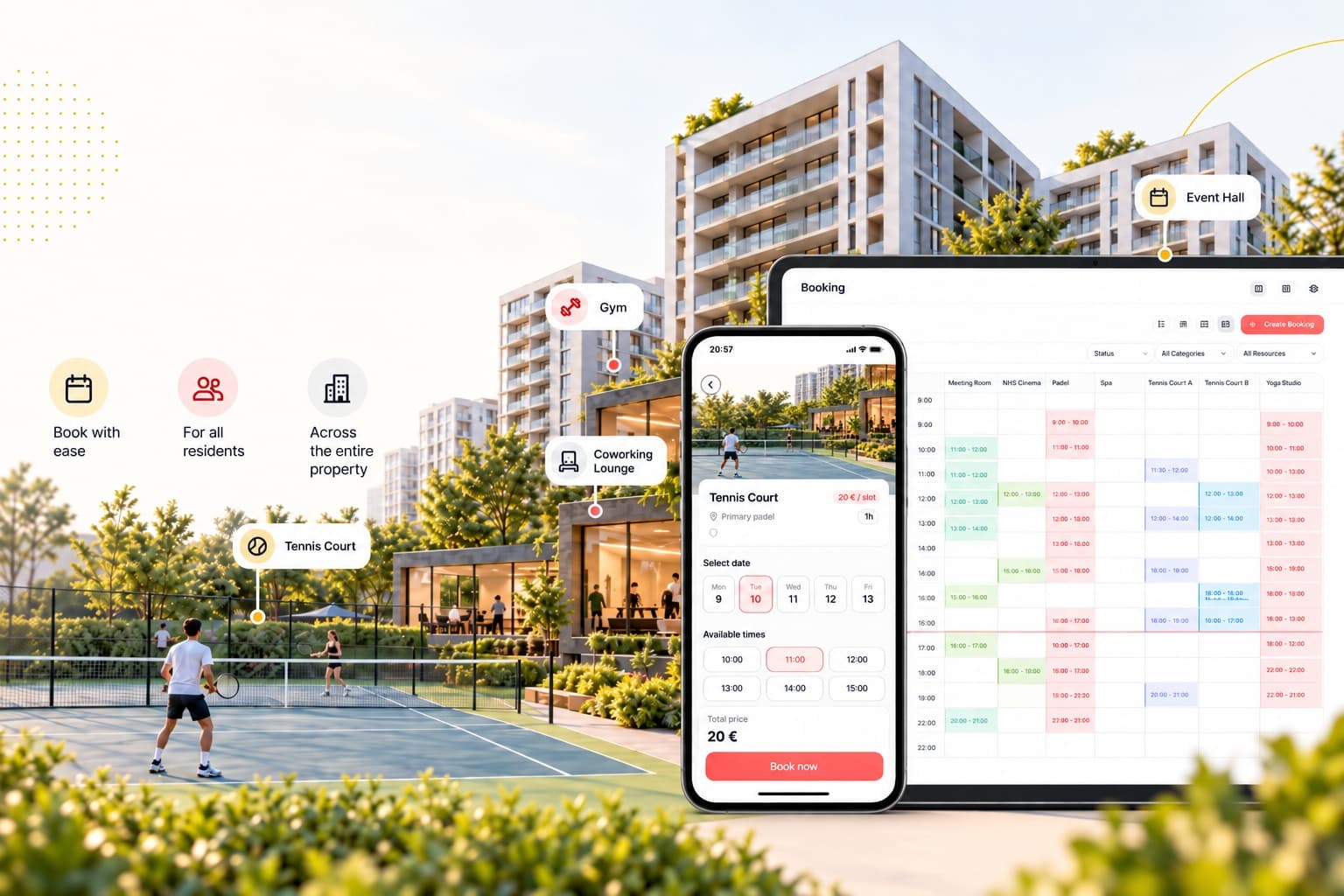
Unitify treats shared amenities as a property-wide resource, not a per-building one. Residents book directly in the app — gym, courts, coworking space, event hall, whatever the complex has — and see live availability instead of guessing. Payment is built into the same booking flow, so paid amenities like a private parking spot or a pay-per-use coworking desk get charged the moment the slot is booked, not chased down afterward. If a community needs limits — a cap on hours per unit, a set booking window — the management company can configure that too, though nothing is imposed by default.
Why it matters more across buildings
This matters most in communities where the amenity was built to serve everyone from day one — a shared rooftop across three towers, a coworking space meant for the whole complex, not one entrance. Without a shared system, "shared" amenities quietly become first-come-first-served for whoever lives closest, or whoever's fastest with a WhatsApp message. With one booking layer across the whole community, the amenity actually functions the way it was designed to.
The bottom line
A shared amenity that nobody can reliably book isn't an amenity — it's a source of complaints. Building the booking logic around the whole community, not one entrance at a time, is what turns "shared" from an aspiration on the brochure into something that actually works.