
Гиды по городам
5
минут чтения

The best technician on your team may also be the worst planner. And that is perfectly fine.
You hire a handyman because they can fix a leaking riser. Not because they can optimize a route across four buildings, remember which apartment cancelled a visit, and notice that they have been double-booked at 2 p.m.
These are two completely different skills. Yet property management companies often treat them as one job.
Bad planning costs more than time
Poor scheduling does not only create delays. It affects the entire team.
One technician completes 11 jobs while another handles three—and both of them notice the imbalance. A cleaner arrives while the electrician is still working in the apartment. Someone gets blamed for a delay that was already built into the schedule several days earlier.
At that point, a planning problem starts to feel personal.
Employees may think that someone is not working hard enough. Managers spend time resolving conflicts instead of coordinating operations. Residents see only the final result: missed appointments, delayed repairs, and unclear completion dates.
The underlying problem is often much simpler—the workload was never visible in one place.
Small scheduling mistakes multiply at scale
At 20 apartments, a scheduling mistake is an apology. At 1,000, it becomes a queue.
One missed appointment on Monday pushes several jobs into Tuesday. Tuesday’s backlog takes time away from Wednesday’s planned maintenance. By Thursday, technicians are dealing with urgent problems instead of preventing them.
Residents start asking for updates. Managers spend the day explaining delays instead of making decisions. The team becomes reactive, even though no single major failure has occurred.
Nothing broke. The workload simply stacked up.
That is the reality of scale: it does not necessarily create new operational problems. It multiplies the ones a smaller team could previously manage through calls, chats, and personal agreements.
Two new ways to plan work in Unitify
The Unitify tickets screen already gives managers a central view of incoming requests. They can see ticket urgency, responsible employees, current statuses, and other important information.
We have now added two new ways to organize this work: Calendar and Kanban.
Together, they help managers understand not only what needs to be done, but also when it is scheduled, who is responsible, and where delays are beginning to form.
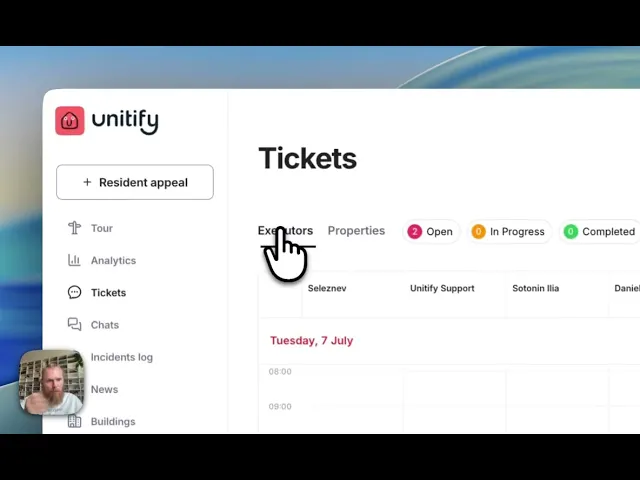
In the short video below, Unitify founder Ilia Sotonin—who previously managed operations across more than 20,000 residential units—shows how Calendar and Kanban help teams prevent scheduling bottlenecks and keep maintenance tasks under control.
Calendar: see the day before it becomes a problem
The Calendar view shows all scheduled work for a particular building.
Managers can see when elevator technicians, handymen, cleaners, and other specialists are expected on-site. Instead of reconstructing the day from separate chats and task lists, they get one clear building schedule.
The Calendar can also display work by executor. This makes it easier to see:
which employees already have a full schedule;
who can take on additional tasks;
where appointments overlap;
whether workloads are distributed evenly;
when work should be reassigned before a delay occurs.
New tickets can be created directly from the Calendar, reducing the need to move between different screens.
Kanban: understand how work is progressing
The Kanban view brings all tickets for a building together on one screen.
Managers can see the overall workload, review what each employee is working on, and identify tasks that have stopped progressing. Tickets can be moved between stages with drag and drop, making status updates quick and intuitive.
The board can also be viewed by executor. This gives managers a clearer understanding of individual workloads without repeatedly asking employees for updates or searching through conversations.
When the workload is visible, discussions stop being about who is working hard enough. They become about what needs to be done, what is blocking progress, and where additional resources are required.
Let specialists focus on their strengths
Technicians should be able to concentrate on diagnosing problems and completing repairs. Cleaners should know where and when their work is scheduled. Managers should have the information they need to decide what gets done, by whom, and when.
Calendar and Kanban views separate these responsibilities more clearly.
The specialist keeps doing what they do best: solving the problem.
The manager gets a better tool for planning the work around them.
Whether a company manages 500 households or 1,000, the goal remains the same: a visible workload, a coordinated team, and calmer daily operations.
Book a demo and we'll help you set the processes up properly — not just switch on the software.